Knossos Frescoes And The Throne Room: What A Guide Points Out
Most of the frescoes you see at Knossos are copies, the originals live in the Heraklion Archaeological Museum, and the Throne Room's purpose is still debated. The right guided visit explains both halves of that story in one day.
Short answer
The frescoes visible at the Palace of Knossos, including the charging bull at the North Entrance, the Queen's Megaron dolphin and the Throne Room griffins, are copies. The originals, among them the bull-leaping fresco and the Prince of the Lilies fragments, are held in the Heraklion Archaeological Museum. The Museum Combo, Small Group trip includes both entrance tickets with a licensed guide, from €225 per person.
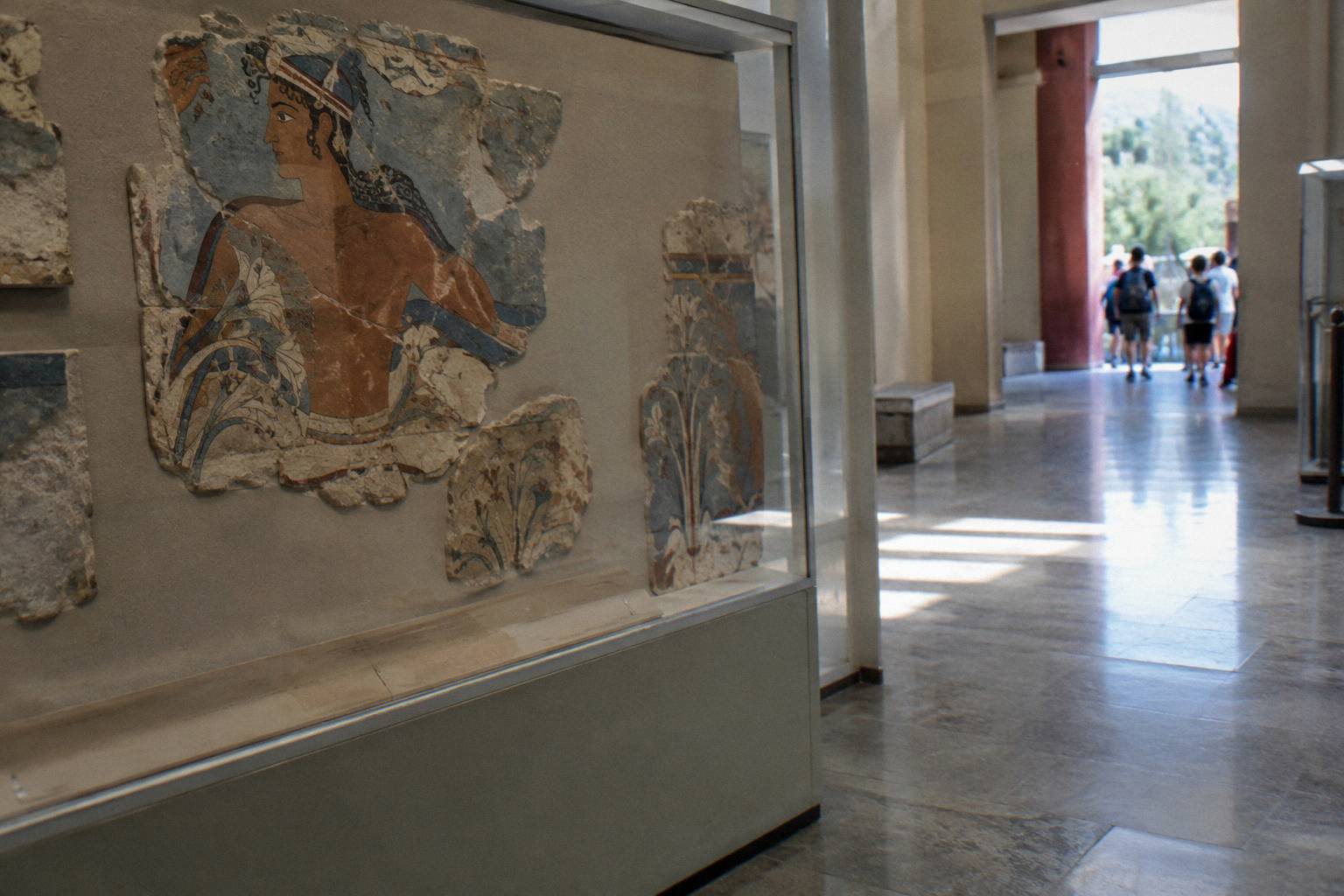
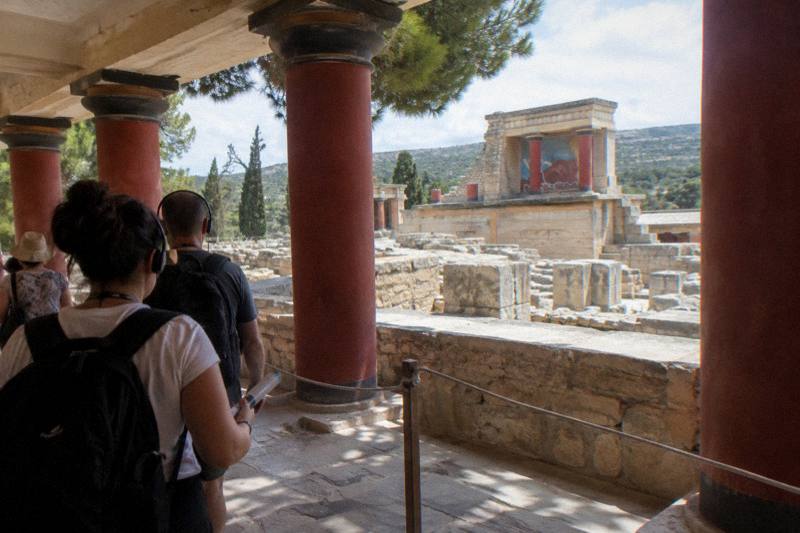
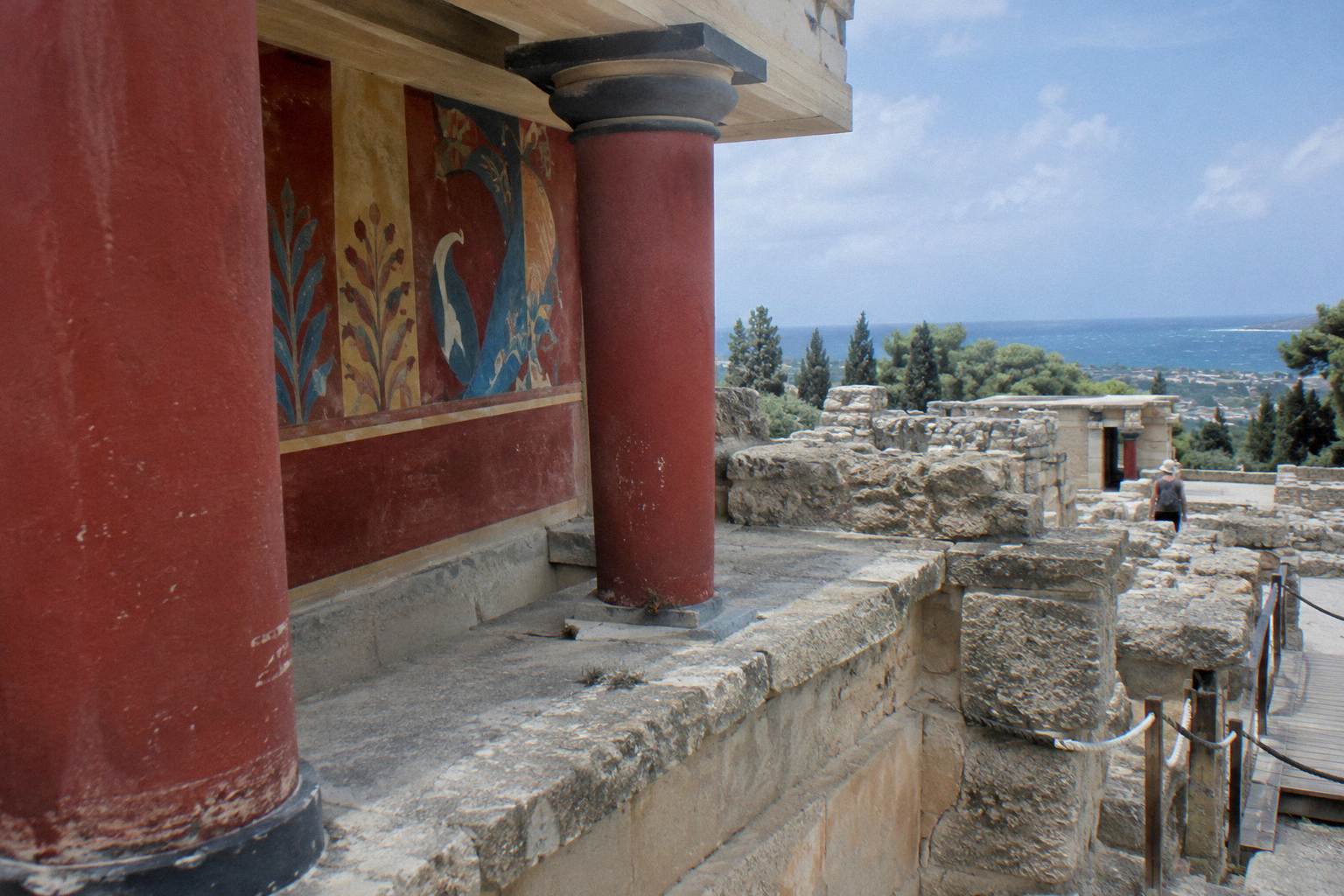
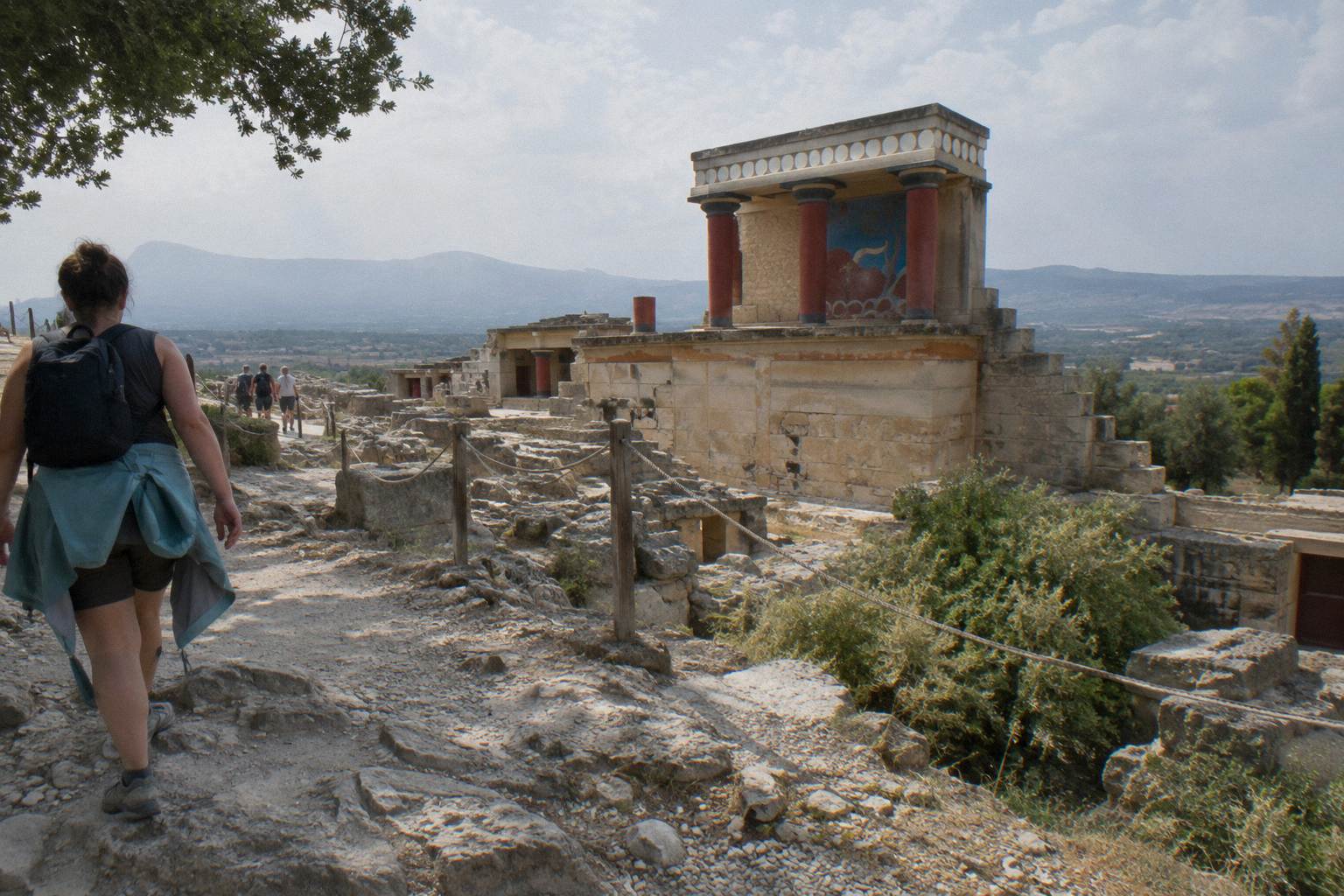
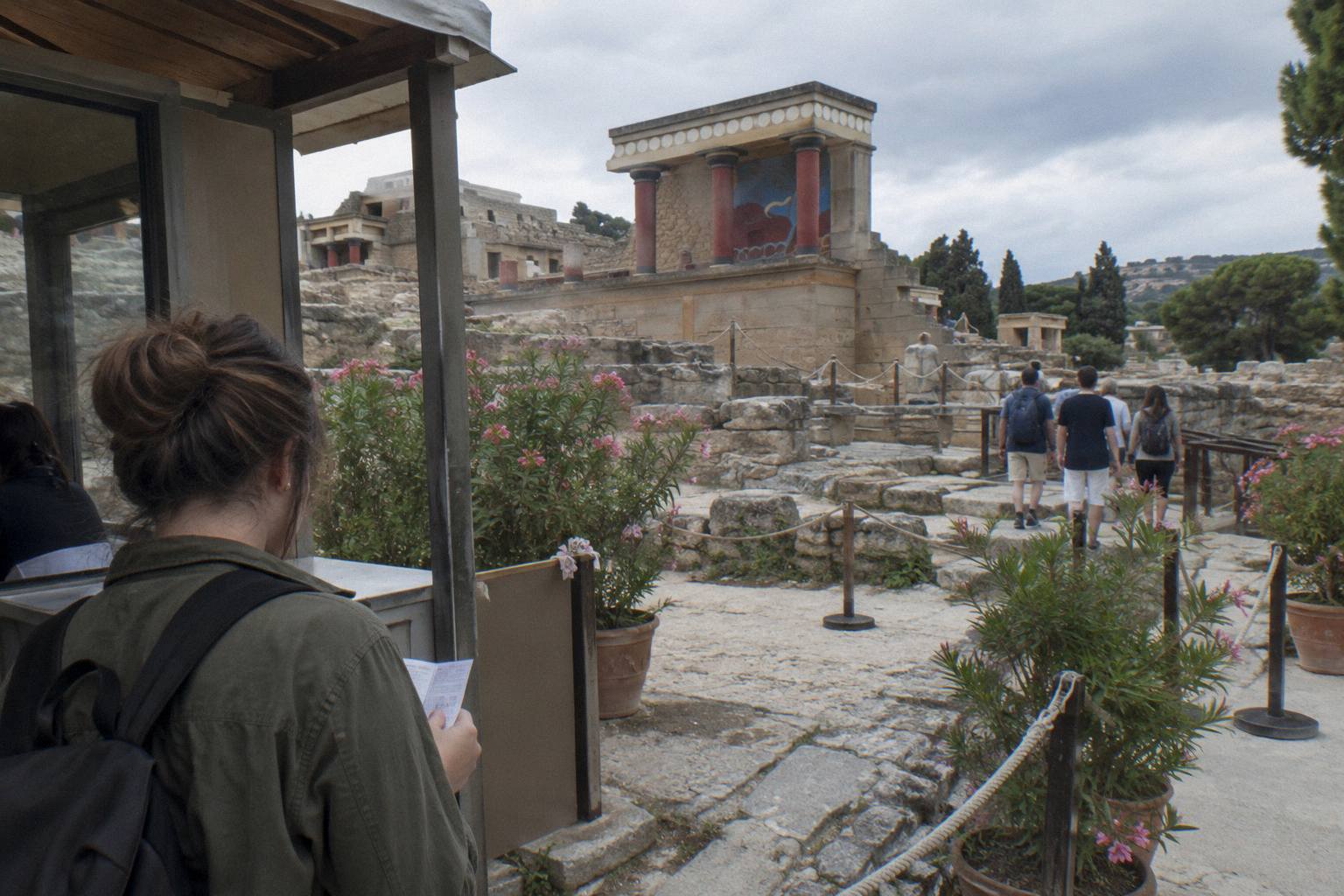
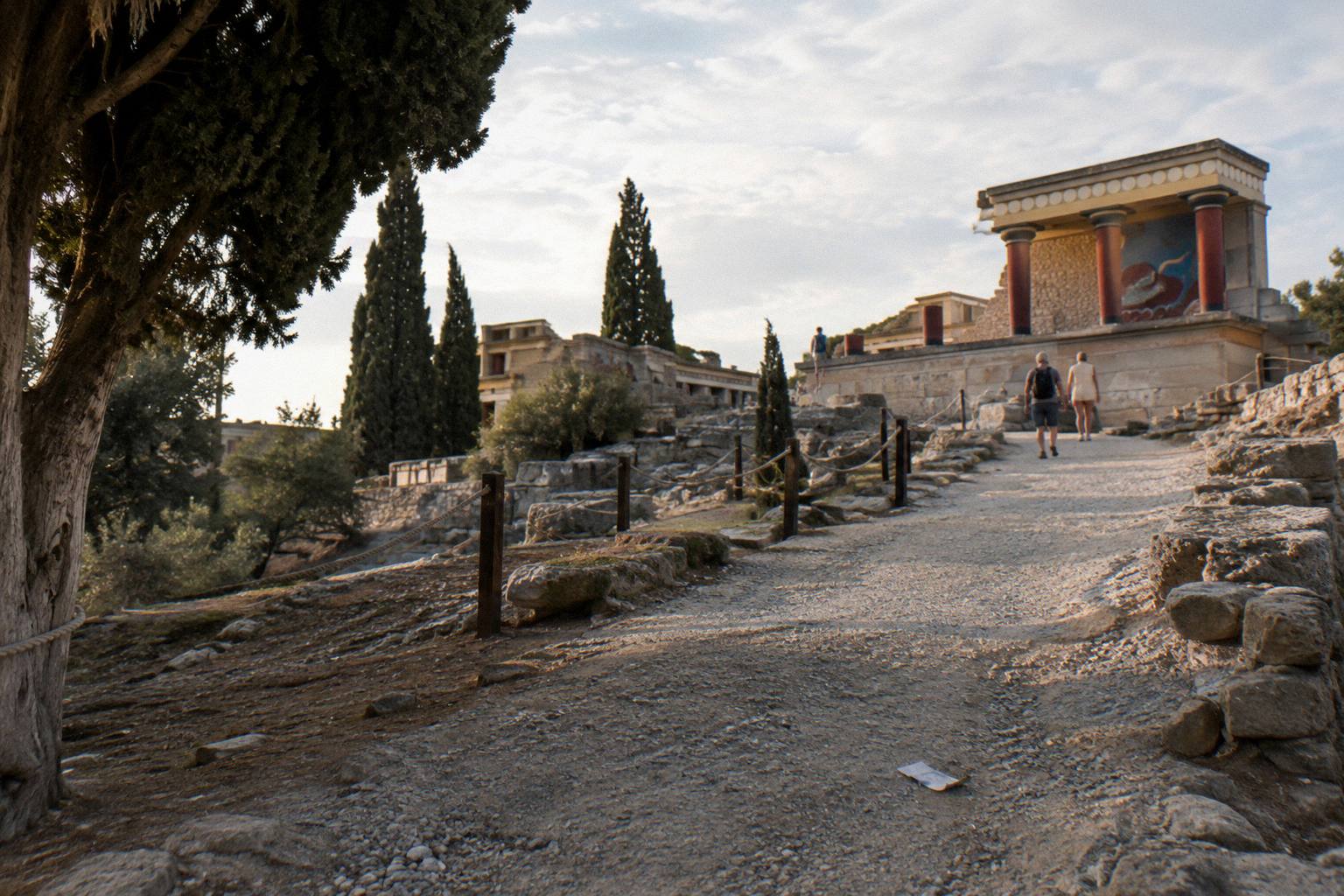
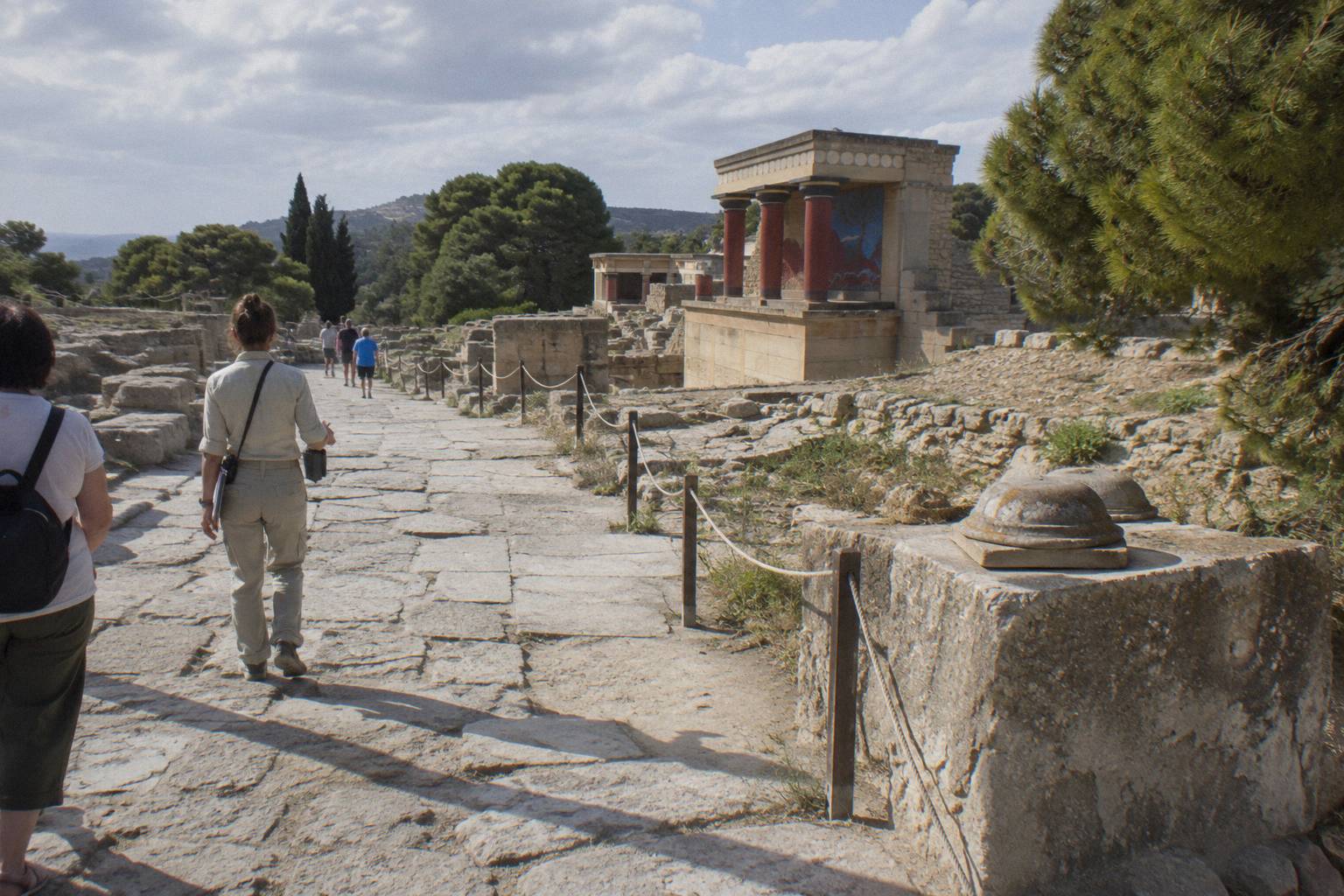
The most painted walls in Greece are mostly not what they seem. Visitors walking through the Palace of Knossos see a charging bull above the North Entrance, a dolphin swimming across the Queen's Megaron and griffins flanking the Throne Room, yet every one of those panels is a copy, set into concrete reconstructions built more than three thousand years after the originals were painted. The real fragments, the bull-leaping fresco, the dolphin, the Prince of the Lilies pieces, sit a short drive away in the Heraklion Archaeological Museum, which holds the Minoan finds.
That split, copies at the palace and originals in the museum, about 5 km north in the city, is the single most useful thing to understand before choosing a trip. It explains why some visits pair the two sites in one day, why a licensed guide changes what the painted rooms mean, and why the Throne Room, a small chamber with a gypsum throne against the wall, benches and a lustral basin, remains a room whose function archaeologists still debate. The palace itself was inscribed in 2025 as part of the UNESCO World Heritage Site 'Minoan Palatial Centres', and Knossos Greece Tours covers the trips that visit it.
What Are The Knossos Frescoes?
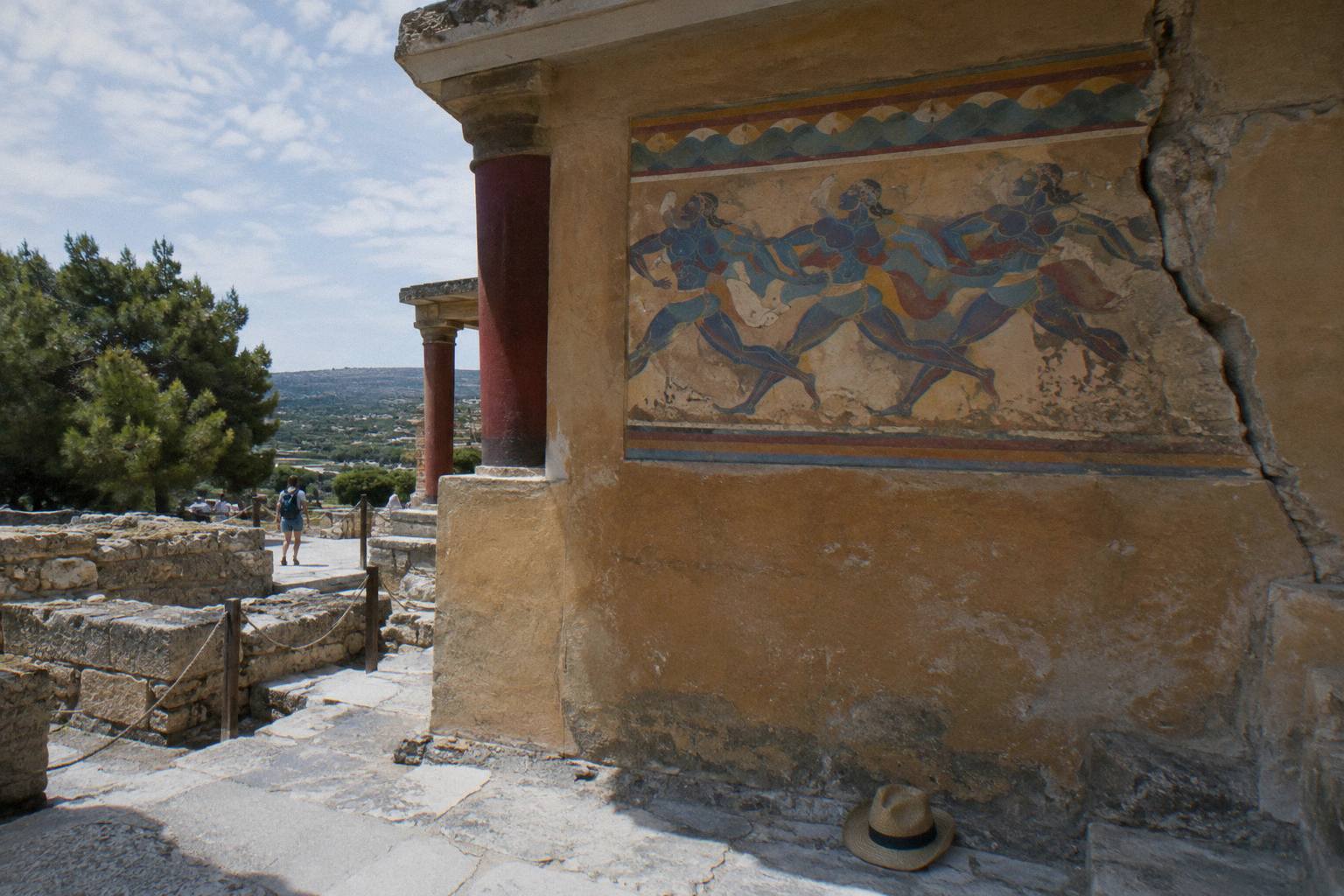
The Knossos frescoes are Minoan wall paintings from the palace at Knossos, executed in pigment on wet plaster and known today mainly from fragments. What stands on the site is generally reconstructed copy work fixed into Arthur Evans' concrete restorations, while the surviving original pieces, the bull-leaping fresco, the dolphin and the Prince of the Lilies or Priest-King fragments, are held in the Heraklion Archaeological Museum.
The palace has two building phases behind it. People settled the Knossos hill in the Neolithic period, from about 7000 BCE. The first palace rose soon after 1900 BCE and was destroyed by an earthquake around 1700 BCE; a second palace was built on top of it, and most of what visitors see today dates from that second palace. The fresco fragments recovered from the site belong to this Minoan world, and the painted panels now mounted at the entrances and rooms are later reconstructions assembled from those fragments and from Evans' reading of them.
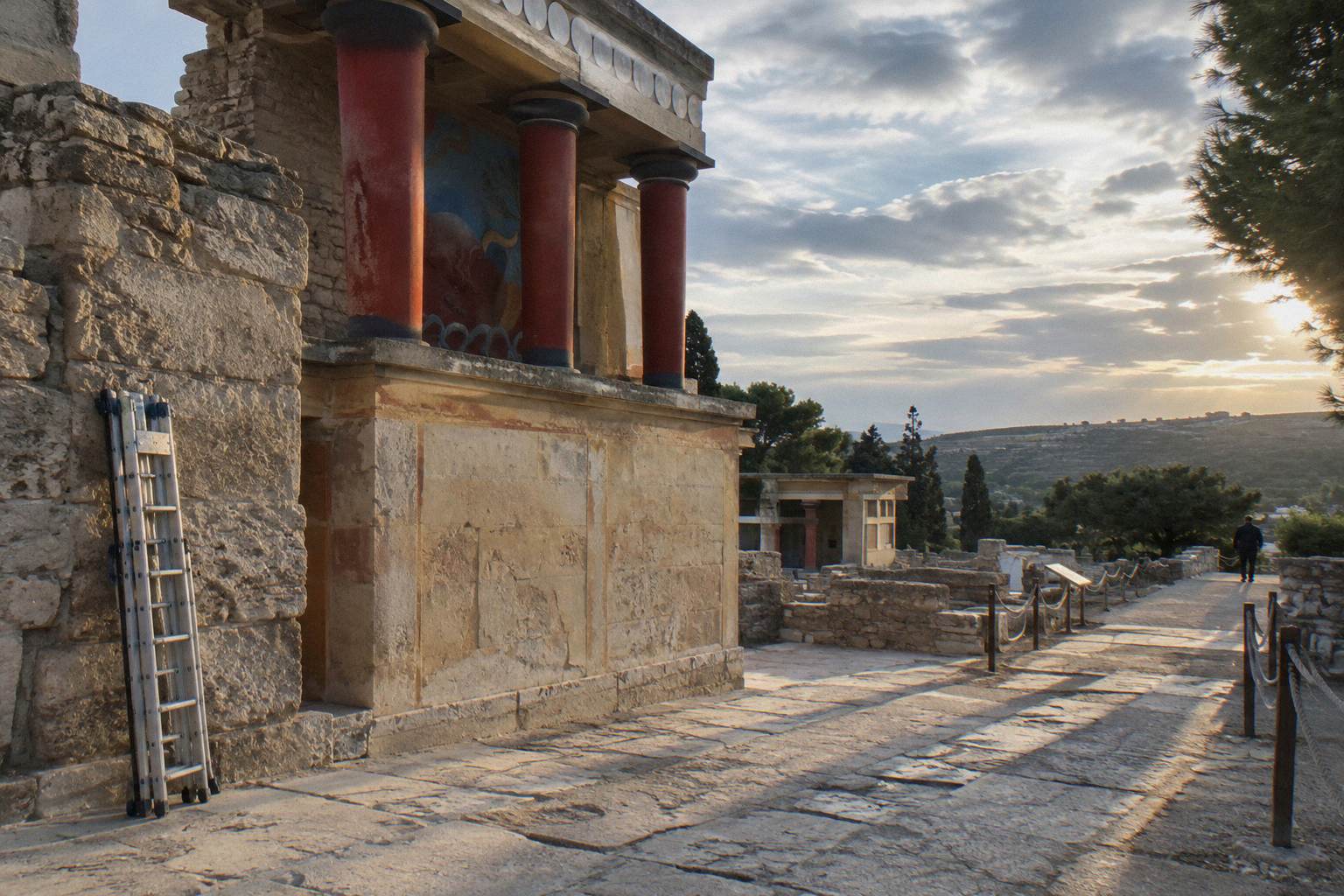
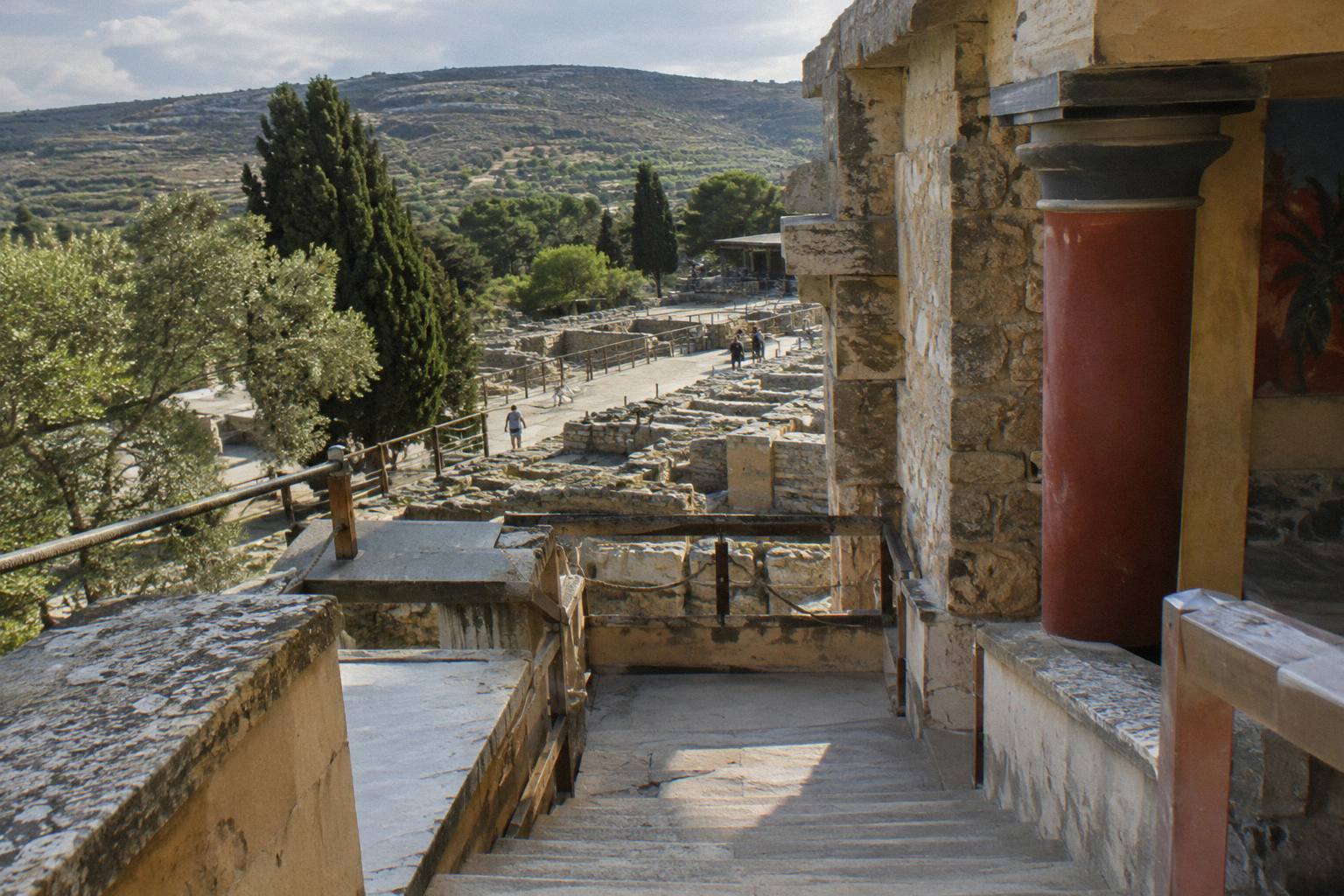
That reading matters for anyone standing in front of a wall. Arthur Evans began systematic excavation on 23 March 1900, bought the site and donated it to the British School at Athens in 1924. His team went beyond digging: they poured concrete columns, walls and staircases to recreate parts of the building at a conjectured height, and they set reconstructed frescoes into that framework. Archaeologists have argued about the reconstructions ever since, and the argument started while Evans was still alive. The colourful panels are beautiful, and they are also interpretation, presented as architecture.
A guide who explains that distinction, copy here, original there, Evans' guess in the middle, turns a photo stop into a story about how the past gets rebuilt. A guide who does not leaves many visitors photographing concrete poured after 1900 under the impression it is a three-thousand-year-old wall. For a wider look at how the visit fits together, see what you see at the palace on a guided visit.
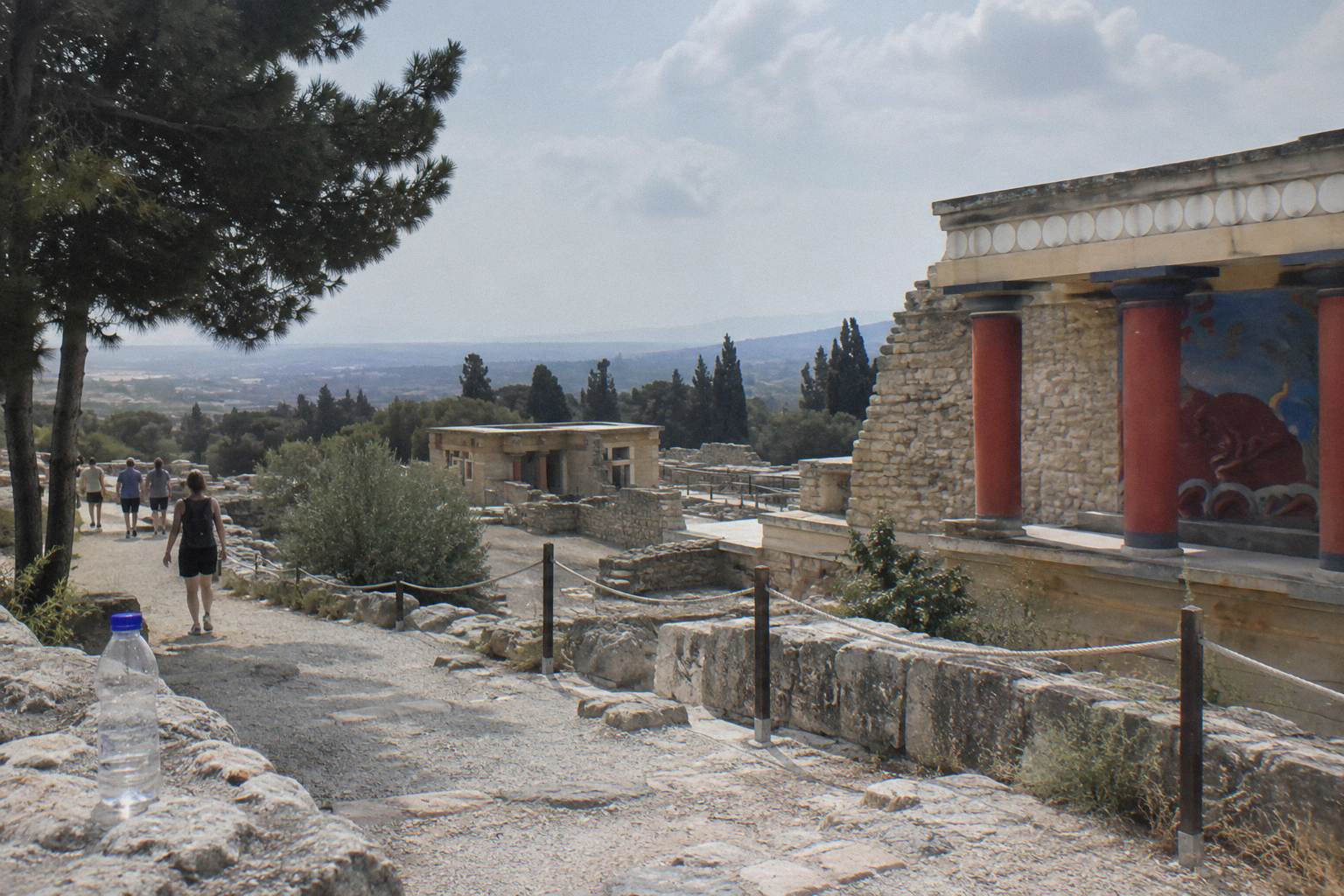
Where Are The Originals Of The Knossos Frescoes?
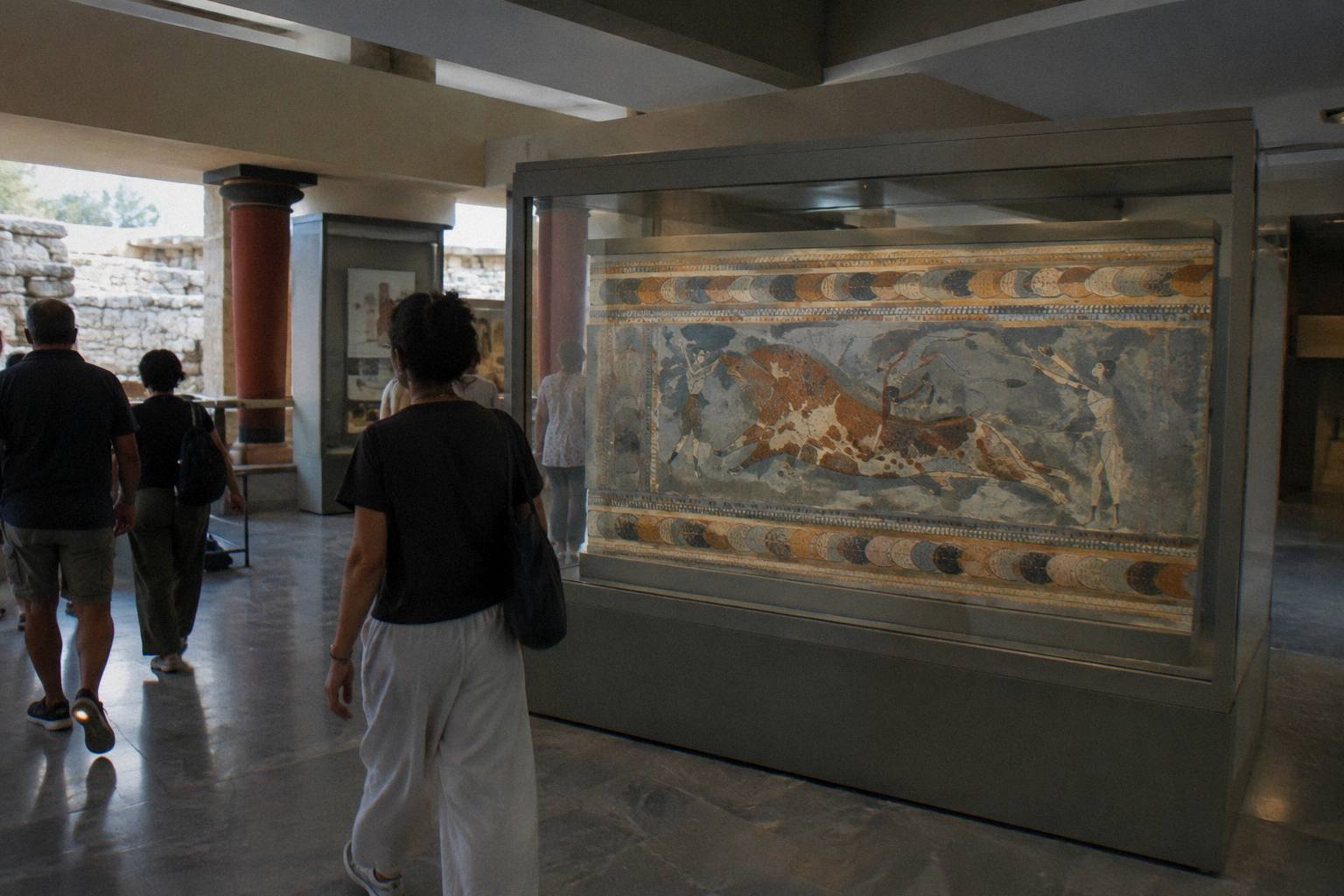
The originals of the Knossos frescoes are in the Heraklion Archaeological Museum in Heraklion city, about 5 km north of the palace and usually 10 to 15 minutes away by car or taxi. The museum holds the Minoan finds, including the bull-leaping fresco, the Phaistos Disc and the snake goddess figurines, which is why several trips combine the palace with a museum add-on or include both tickets outright.
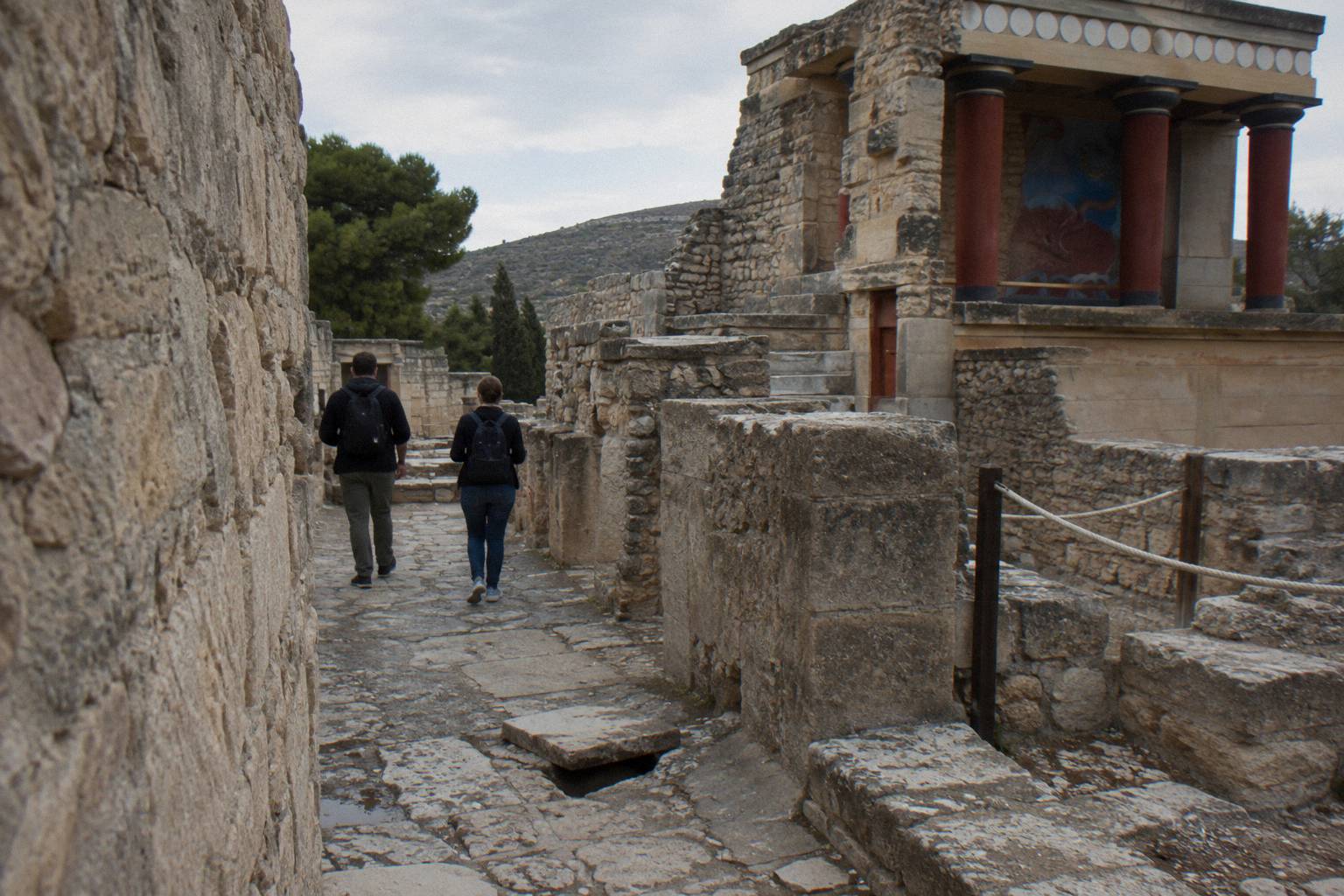
The museum side of the story is the half most day visitors miss. The bull-leaping fresco, the famous panel of acrobats somersaulting over a bull, survives as original fragments in the museum's collection; the charging-bull panel at the North Entrance of the palace is a replica. The dolphin copy in the Queen's Megaron has its original counterpart in the same city. Even the room names are part of the interpretation: 'Queen's Megaron', 'Priest-King' and 'Throne Room' are all Evans' own labels, not Minoan ones, and no claim can be made that archaeologists agree on what any of these rooms were for.
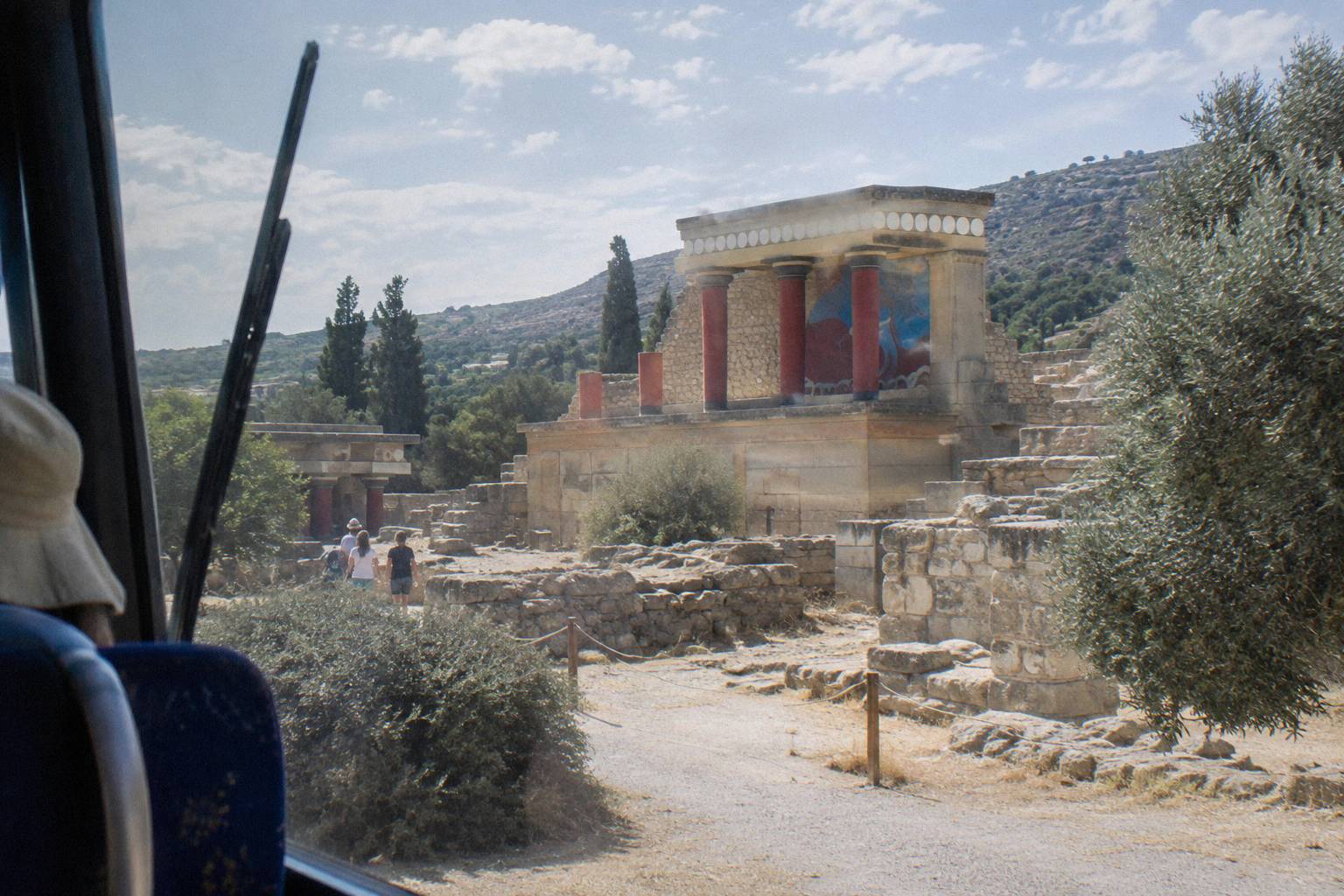
Because of that split, the trips that put the palace and the museum on the same day do the most for a reader whose interest is the frescoes. The Museum Combo, Small Group trip from Business Management Services L.P. includes entry tickets for both the palace and the Archaeological Museum, with a licensed tour guide for a guided tour in a small group, skip-the-ticket-line service and headsets when the group is over 6; it runs 5 hours. Other palace visits, among them the Small Group, Skip The Line trip from Experience Travel Crete and the KnossosGuides, Ticket Included trip, offer the museum as an optional add-on after the palace visit. On private driver-led days the museum entrance is excluded and paid separately.
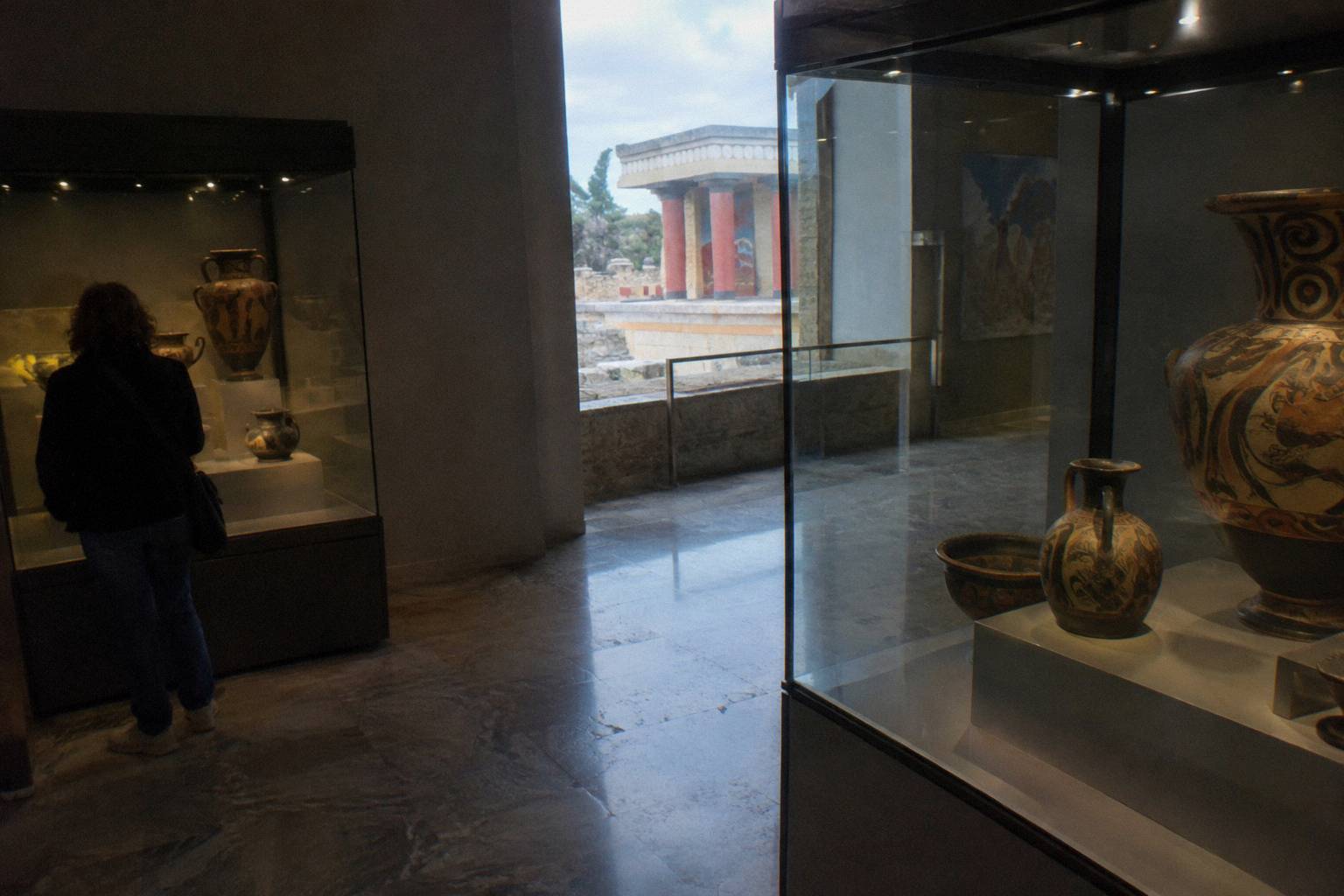
The two-site combinations differ in format more than in content. A shared small-group visit moves on a fixed schedule with a licensed guide inside the palace; a private day moves at your pace with a driver, and on most private trips the licensed guide inside the palace is an extra rather than included. Neither is better for the frescoes in the abstract; the question is whether you want the museum guided or independent, and whether a licensed guide inside the palace is part of the price. The guide to seeing the palace and museum on one tour walks through the same combinations in more detail.
One planning note: the museum's own ticket, hours and free days are published on its official channels and are not covered by any palace schedule, and no combined palace plus museum ticket exists to buy independently. The only way to have both entrances handled in one booking, among the trips covered here, is the Museum Combo, Small Group trip, which is exactly what makes it the natural pairing for anyone coming for the paintings rather than the ruins alone.
What Is In The Throne Room?
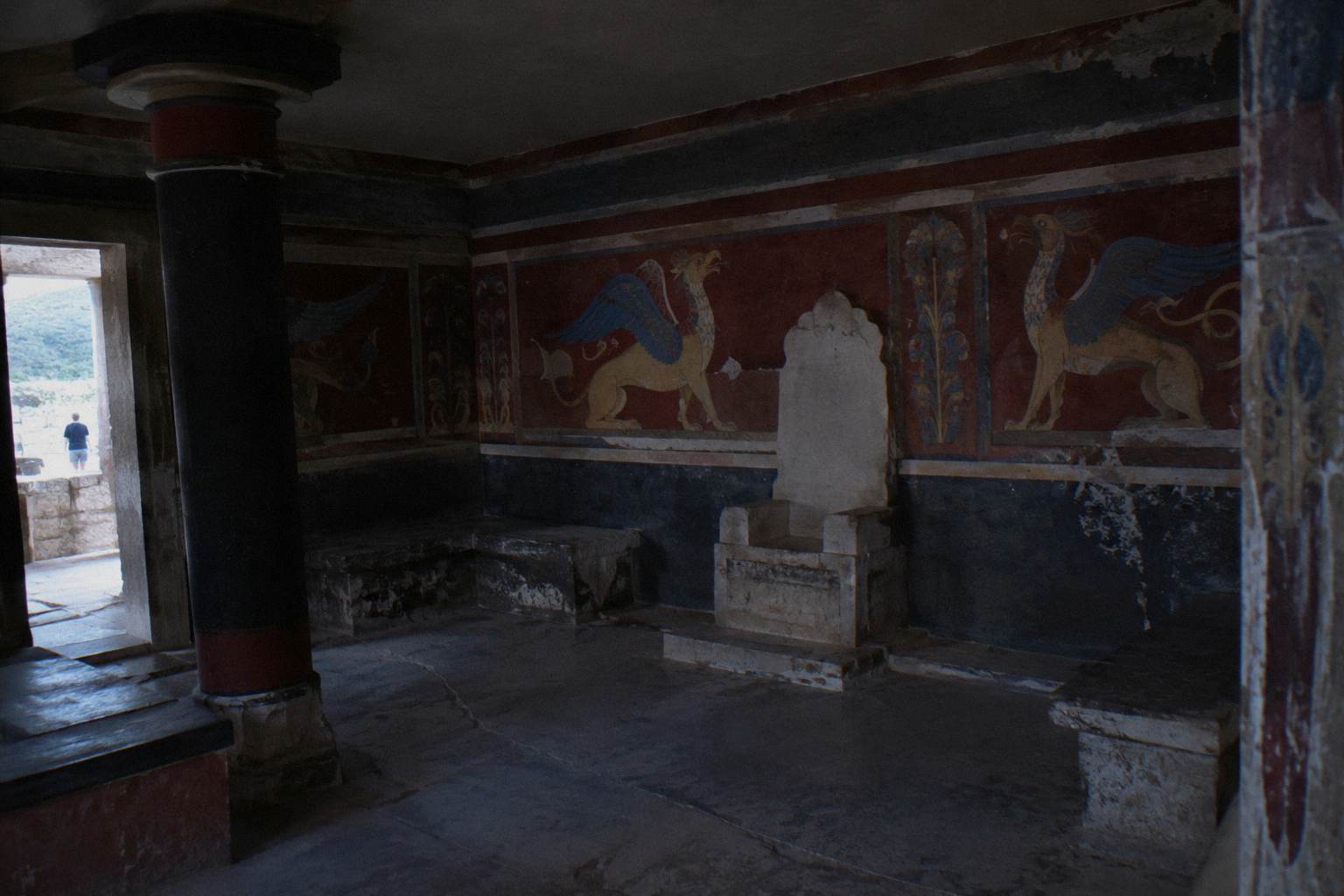
The room packs an unusual amount of interpretation into a few square metres. The gypsum throne against the wall and the benches are ancient; the griffin frescoes that frame the space are reconstructed, and the concrete upper structure around them is Evans' work. The lustral basin, a small sunken area reached by steps, is one of the features archaeologists read in several ways, and the debate about the room's function is genuine and long-running, not a detail for specialists. Even the label 'Throne Room' is Evans' wording, coined before modern scrutiny of his methods.
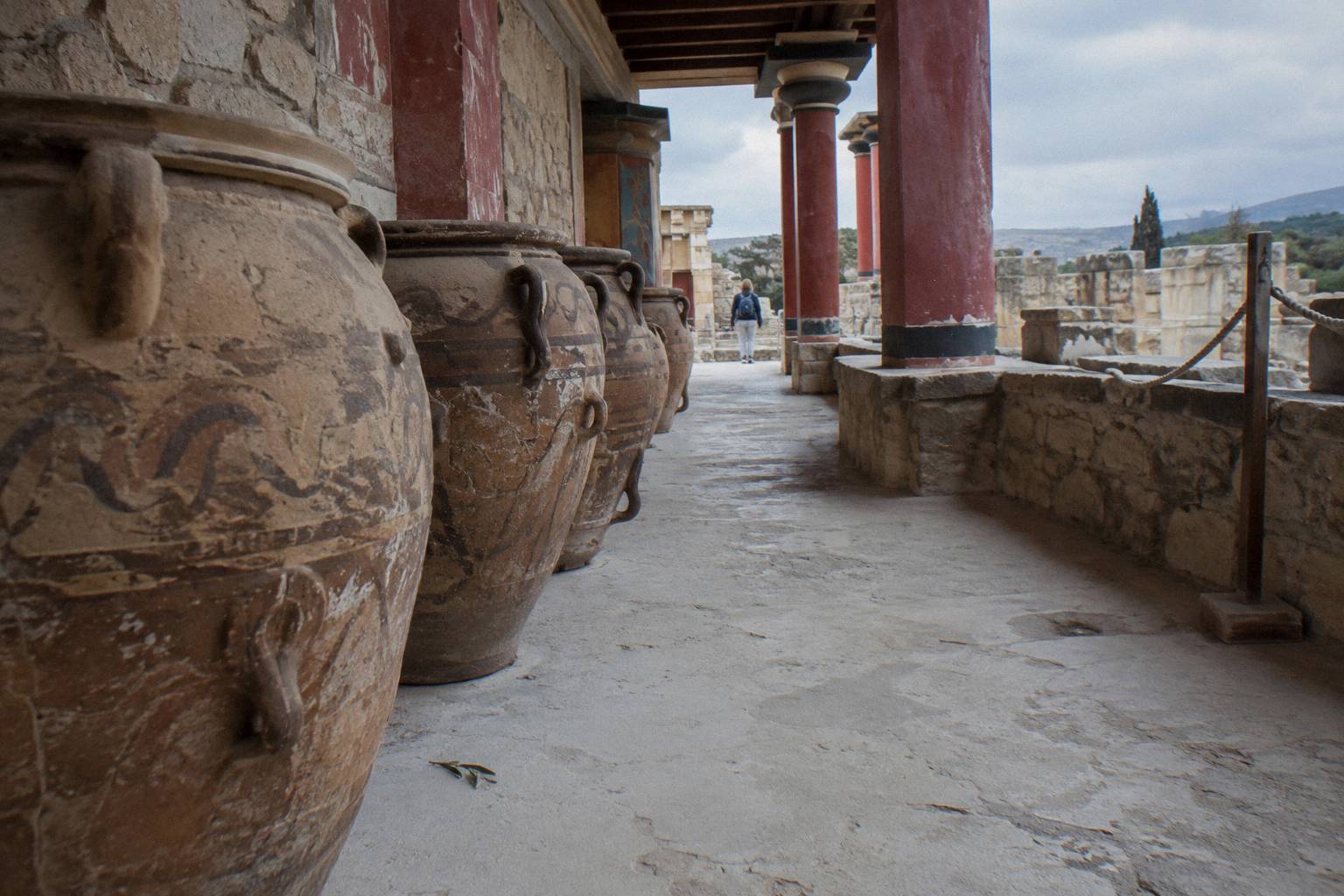
What a licensed guide adds here is context rather than certainty. A guide can lay out the competing readings of the room, explain which parts are original and which are reconstruction, and place the Throne Room within the wider complex: the Central Court, a large paved rectangular court at the heart of the palace, the largely reconstructed Grand Staircase, the Royal Road, the Theatral Area, the South Propylaeum and the West Magazines with their giant storage jars, many of them original. No trip here can promise that a guide stops at any given room, and the palace route on the day depends on the operator and the schedule, so treat the room list as what the site holds rather than a fixed itinerary.
The myth layer belongs here too, framed as myth. Legend has it that the Minotaur dwelt in a Labyrinth at Knossos and that Theseus found his way out with a thread; later Greek tradition tied that legend to the palace's complex layout. The story is a story told about the building, not a fact of the building, and a good guide says so plainly. There is no labyrinth to be shown, only a complicated palace and a famous legend attached to it. The deeper background on how guides handle the myth sits in what guides say about the labyrinth of Knossos.
Which Trips Put The Palace And The Museum Together?
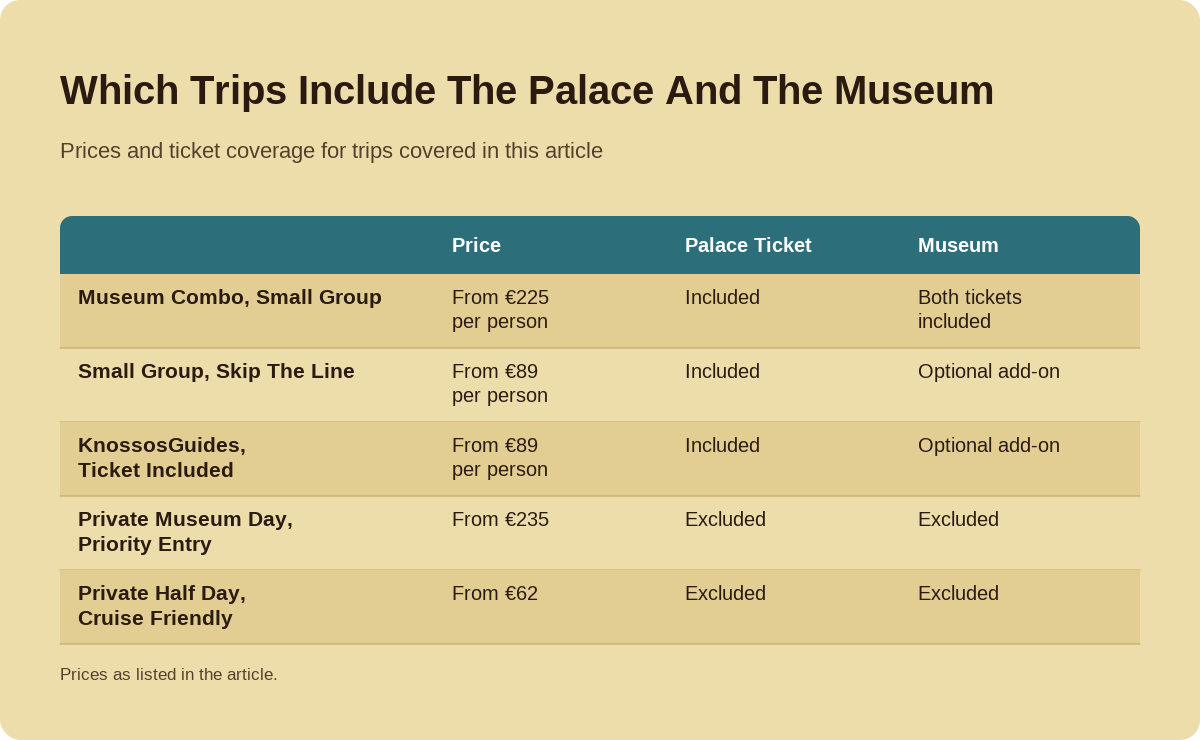
Only one trip among those covered here includes both the palace and the Heraklion Archaeological Museum on one ticket: the Museum Combo, Small Group trip from Business Management Services L.P., from €225 per person, with a licensed tour guide in a small group. Several shared palace visits offer the museum as an optional add-on instead, while private days mostly exclude both entrances and leave the museum to you.
The Museum Combo, Small Group trip is the closest match to this article's question. It is rated 4.7 across 37 reviews, runs 5 hours, includes the entry tickets for the palace and the Archaeological Museum along with a skip-the-ticket-line service, and puts a licensed tour guide with the small group; headsets are provided when the group is over 6. Free cancellation applies up to 24 hours before the start. For a reader whose aim is the frescoes in both places, copies at the palace and originals in the museum, this is the trip built for exactly that. The Museum Combo, Small Group trip page carries the full detail, and you can check availability for your dates.
The shared palace-only visits handle the museum differently. The Small Group, Skip The Line trip from Experience Travel Crete, from €89 per person and rated 4.8 across 319 reviews, includes the palace entry ticket and a licensed tour guide, with the Archaeological Museum as an optional add-on; the same add-on structure applies to the Ticket With Live Guide trip and the KnossosGuides, Ticket Included trip, both also from €89 per person. On these, the museum half is your own arrangement after the palace visit ends, which suits readers who are happy to walk the museum independently.
The private side works the other way round. The Private Museum Day, Priority Entry trip from Crete Wanderer, from €235, rated 4.8 across 69 reviews and running 10 hours, offers flexible door-to-door pickup and drop-off in a private air-conditioned vehicle with an English-speaking driver, a customisable itinerary and priority entry assistance at the palace; entrance fees are excluded and a licensed guide inside the archaeological sites is an optional extra. The licensed guiding, in other words, is not part of the base price on that format. For a fuller comparison of the two approaches, whether a guided visit, an audio guide or going alone suits you breaks down the trade-offs.
The table below summarises how each format treats the two entrances and the guiding, using each trip's own terms. Prices are per-trip facts, and the museum's own ticket is a separate purchase on every row except the first.
| Trip | Price | Palace Ticket | Museum | Guide Inside The Palace |
|---|---|---|---|---|
| Museum Combo, Small Group (Business Management Services L.P.) | From €225 per person | Included | Both tickets included | Licensed tour guide, small group |
| Small Group, Skip The Line (Experience Travel Crete) | From €89 per person | Included | Optional add-on | Licensed tour guide, group |
| KnossosGuides, Ticket Included (KnossosGuides) | From €89 per person | Included | Optional add-on | Licensed tour guide, small group |
| Private Museum Day, Priority Entry (Crete Wanderer) | From €235 | Excluded | Excluded | Driver only; licensed guide optional, excluded |
| Private Half Day, Cruise Friendly (SunSud Tours) | From €62 | Excluded | Excluded | Driver-host; licensed guide an optional extra |
Why Are The Evans Reconstructions At Knossos Debated?
Evans' concrete reconstructions at Knossos, the columns, walls and staircases that carry the copied frescoes, are controversial and debated, and were already contested in his own time. Critics argue the concrete fixes one man's interpretation permanently into the archaeology; supporters answer that without it the second palace would be far harder to read, and his room names are acknowledged as his own interpretations.
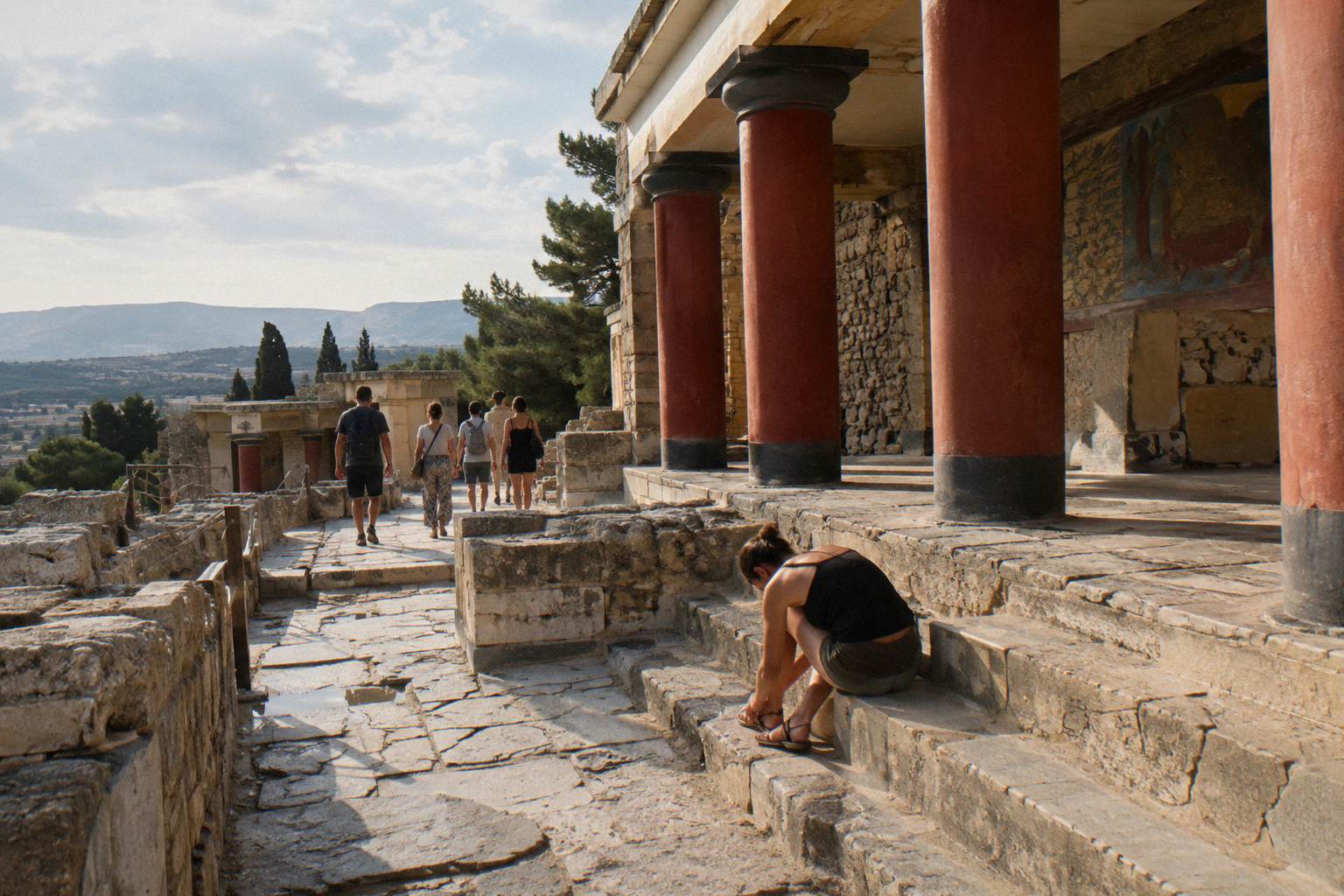
The debate is worth understanding because it shapes what every visitor photographs. The Grand Staircase is largely reconstructed. The Throne Room's upper structure is reconstruction. The charging-bull panel at the North Entrance is a replica mounted on rebuilt masonry. A visitor who knows this walks the site with two layers visible at once: the Minoan remains below and Evans' reading from 1900 onward above. Minos Kalokairinos made the first excavations in 1878, two decades before Evans arrived, and Evans' purchases and donations eventually placed the site in public custodianship, which is part of why his reconstructions became the permanent frame everyone now sees.
A licensed guide is the difference between hearing that story and guessing at it. The palace's licensing question has its own wrinkles, though: on several trips the person with you inside the palace is a driver-guide, not a licensed guide, and the licensed guide is an extra. The question whether the guide on a Knossos tour is licensed or just the driver goes through it trip by trip, and it matters most for readers who specifically want the frescoes and the Throne Room explained rather than pointed at.
What Does The Palace Ticket Cover On The Official Schedule?
The Palace of Knossos costs €20 for the full ticket and €10 for the reduced ticket on the official Ministry of Culture schedule, with no summer or winter price difference. Hours are seasonal and change by year: from 1 April the site opens at 08:00 and closes at 20:00, shortening through autumn, and from 1 November it is open every day, closing in the late afternoon.
The schedule is the only authority for ticket and hours, and it should be read as a schedule, not a promise for a travel date. Last admission is 15 minutes before closing, with the 20:00 summer closing bringing last admission at 19:45; from 1 September closing moves to 19:30, from 16 September to 19:00, from 1 October to 18:30 and from 16 October to 18:00. Free admission days on the schedule are 6 March, 18 April, 18 May, the last weekend of September and 28 October. The site is closed on 1 January, 25 March, Easter Sunday, 1 May, 25 December and 26 December, with shortened hours on Good Friday and Holy Saturday, and the official page carries closure notices worth checking before any visit.
How the ticket interacts with a booking depends entirely on the trip. Some trips include the palace entry ticket and a skip-the-ticket-line service; others exclude it and you pay on site. The Budget Fare Guided Walk from Business Management Services L.P., from €60 per person and rated 4.9 across 63 reviews, is the clearest example: the guided walk includes a licensed tour guide in a small group and a skip-the-line service that buys the tickets through the check-in operator, but the general admission itself is paid separately. The question whether a Knossos tour includes the entrance ticket answers this for every trip covered here, and the seasonal detail sits in the palace opening hours and seasons explained.
| Official Ministry Of Culture Schedule Item | Detail |
|---|---|
| Full ticket | €20 |
| Reduced ticket | €10 |
| Summer hours (from 1 April) | 08:00 to 20:00, last admission 19:45 |
| Autumn closings | 19:30 from 1 September, 19:00 from 16 September, 18:30 from 1 October, 18:00 from 16 October |
| Winter hours (from 1 November) | Open every day, closing in the late afternoon |
| Free admission days | 6 March, 18 April, 18 May, last weekend of September, 28 October |
| Closed days | 1 January, 25 March, Easter Sunday, 1 May, 25 December, 26 December |
What Trips People Up When Comparing Knossos Trips?
Three things trip readers up most often: assuming the palace ticket is included when the trip excludes it, assuming the person guiding inside the palace is a licensed guide when the trip provides a driver-guide, and assuming the museum is part of the day when it is an add-on or excluded. Each of these is a per-trip fact that never carries over from one trip to another, even between trips with near-identical titles.
The first trap is the ticket. Two trips can both read as skip-the-line visits while one includes the €20 palace entrance and the other excludes it. The Small Group, Skip The Line trip from Experience Travel Crete, from €89 per person, includes the entry ticket; the Budget Fare Guided Walk, also skip-the-line in service terms, excludes it. The gap in headline price, €89 against €60, largely closes once the admission is added, which is exactly why comparing headline prices alone misleads. Each trip's own entry is the only reliable source for what the price covers.
The second trap is the guide. A driver-guide and a licensed tour guide are different roles, and on the private Lasithi and museum days the licensed guide inside the palace is usually an optional extra with no figure given. The KnossosGuides, Ticket Included trip, from €89 per person and rated 4.9 across 48 reviews, is unambiguous on this point: a licensed tour guide leads a small group inside the palace, the entry ticket and skip-the-ticket-line service are included, and the Archaeological Museum is an optional add-on. Its pickup and drop-off are excluded, so the meeting arrangement is your own. The KnossosGuides, Ticket Included trip page has the detail, and you can Check availability alongside it.
The third trap is the museum assumption. Only the Museum Combo, Small Group trip includes both tickets. Everything else either offers the museum as an optional add-on or excludes the entrance, and the museum's own ticket is never bundled into a palace price. Readers who want both sites on one booking have exactly one option among the trips here; readers happy to walk the museum alone have several. The wider decision framework, including duration, group size and price per format, is in how to choose which Knossos tour to book.
| Common Assumption | What The Trips Actually Say |
|---|---|
| "Skip-the-line means the ticket is included" | Not always: some trips include the entry ticket, others exclude it and only buy or speed the purchase |
| "The guide inside is licensed" | Only where the trip says licensed tour guide; on private days a driver-guide leads and a licensed guide is an extra |
| "The museum is part of the day" | Included only on the Museum Combo trip; otherwise an optional add-on or excluded |
| "The frescoes on site are original" | Generally copies; the originals are in the Heraklion Archaeological Museum |
A final word on expectations. The frescoes and the Throne Room deliver most to visitors who arrive knowing the copy-versus-original split, because every wall then tells two stories at once: the Minoan painters and the excavators who began work in 1900 and decided how to show them. Whether that context comes from a licensed guide in a small group, a 5-hour palace and museum combination, or your own reading beforehand, the site rewards the preparation. Free cancellation up to 24 hours before the start applies across the trips discussed here, so a change of plan costs nothing.
Common Questions About Knossos Frescoes
Are The Knossos Frescoes On Site Originals?
No. The frescoes seen around the Palace of Knossos are generally copies, including the charging-bull replica at the North Entrance, the dolphin copy in the Queen's Megaron and the reconstructed griffins in the Throne Room. The originals, among them the bull-leaping fresco and the Prince of the Lilies or Priest-King fragments, are held in the Heraklion Archaeological Museum in Heraklion city.
What Is In The Throne Room At Knossos?
The Throne Room is a small room with a gypsum throne against the wall, benches and a lustral basin, flanked by reconstructed griffin frescoes. The name itself is Arthur Evans' interpretation, and what the room was used for is still debated by archaeologists.
Which Tour Includes Both The Palace And The Archaeological Museum?
Among the trips covered here, only the Museum Combo, Small Group trip from Business Management Services L.P. includes entry tickets for both the palace and the Heraklion Archaeological Museum, with a licensed tour guide in a small group, from €225 per person. Several shared palace visits offer the museum as an optional add-on instead.
Why Are The Evans Reconstructions At Knossos Controversial?
Arthur Evans' concrete reconstructions of columns, walls and staircases fix one interpretation of the palace permanently into the site, and the approach was controversial and debated even in his own time. His room names, including Throne Room and Queen's Megaron, are his own interpretations rather than Minoan labels.
Is The Minotaur Labyrinth At Knossos Real?
The Minotaur, the Labyrinth and Theseus are legend, linked by later Greek tradition to the palace's complex layout. There is no labyrinth to see at the site; the palace is a large, complicated building, and the myth is a story told about it rather than a place within it.
How Much Does The Palace Of Knossos Ticket Cost?
The full ticket is €20 and the reduced ticket is €10 on the official Ministry of Culture schedule, with no summer or winter price difference. Hours and free admission days are seasonal and change by year, so check the official page for the current schedule and any closure notices.