Why Is Knossos Controversial? Evans And The Reconstructions
The concrete columns, painted walls and room names at the Palace of Knossos are Arthur Evans' work, and archaeologists have argued about them for a century. What the debate means for a guided visit.
Arthur Evans began systematic excavation at Knossos on 23 March 1900, bought the site with his own money, and later rebuilt parts of it in concrete: columns, walls, an entire staircase. That single sentence is the root of a controversy that has run for more than a century and shows no sign of closing. The Palace of Knossos, about 5 km south of Heraklion on Crete, is the most visited archaeological site on the island and the only major one where the visitor walks through, and not just past, a scholar's interpretation of what stood there.
The argument matters on a visit because it changes what a guide can honestly point at. A wall of original masonry, a concrete reconstruction and a modern copy of a fresco all stand within a few steps of each other, and to an untrained eye they look alike. The licensed guides who lead the small-group visits covered here are the people who separate the three, and knowing the outline of the debate beforehand is what turns a walk through the ruins into a readable site.
The controversy is that Arthur Evans did not only excavate Knossos, he rebuilt it: concrete columns, upper storeys, walls and the Grand Staircase all carry his interpretation, and his room names such as the Queen's Megaron and the Throne Room are his own inventions. Archaeologists have disputed those reconstructions since his lifetime, and the debate has never been settled.
The plain facts are not in dispute. People settled the Knossos hill in the Neolithic period, from about 7000 BCE. The first palace was built soon after 1900 BCE and destroyed by an earthquake around 1700 BCE. A second palace rose on top of it, and most of what a visitor sees today belongs to that second building. Minos Kalokairinos made the first excavations in 1878. Then came Evans, a wealthy British archaeologist, who began systematic digging on 23 March 1900, eventually bought the site outright, and in 1924 donated it to the British School at Athens.
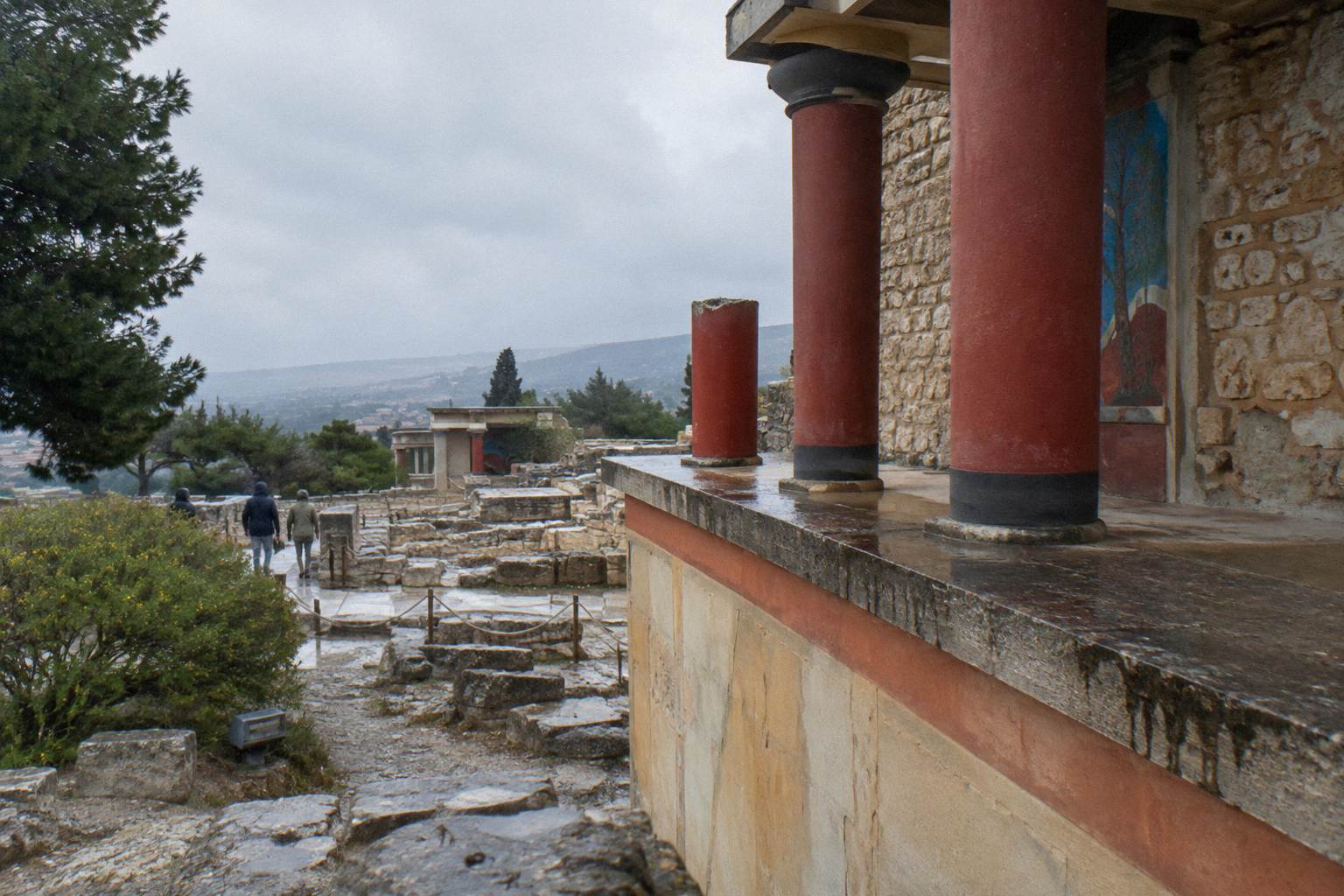
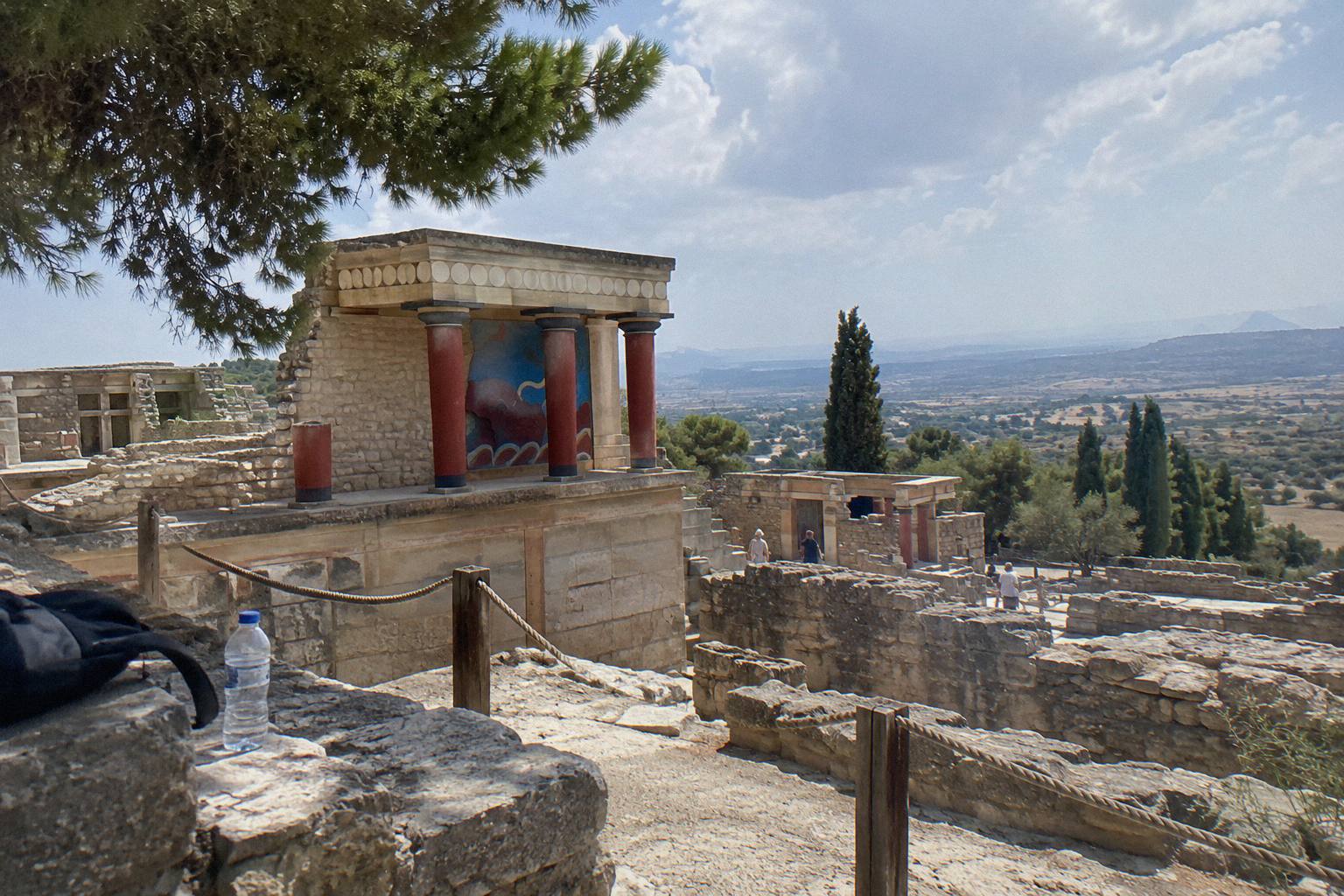
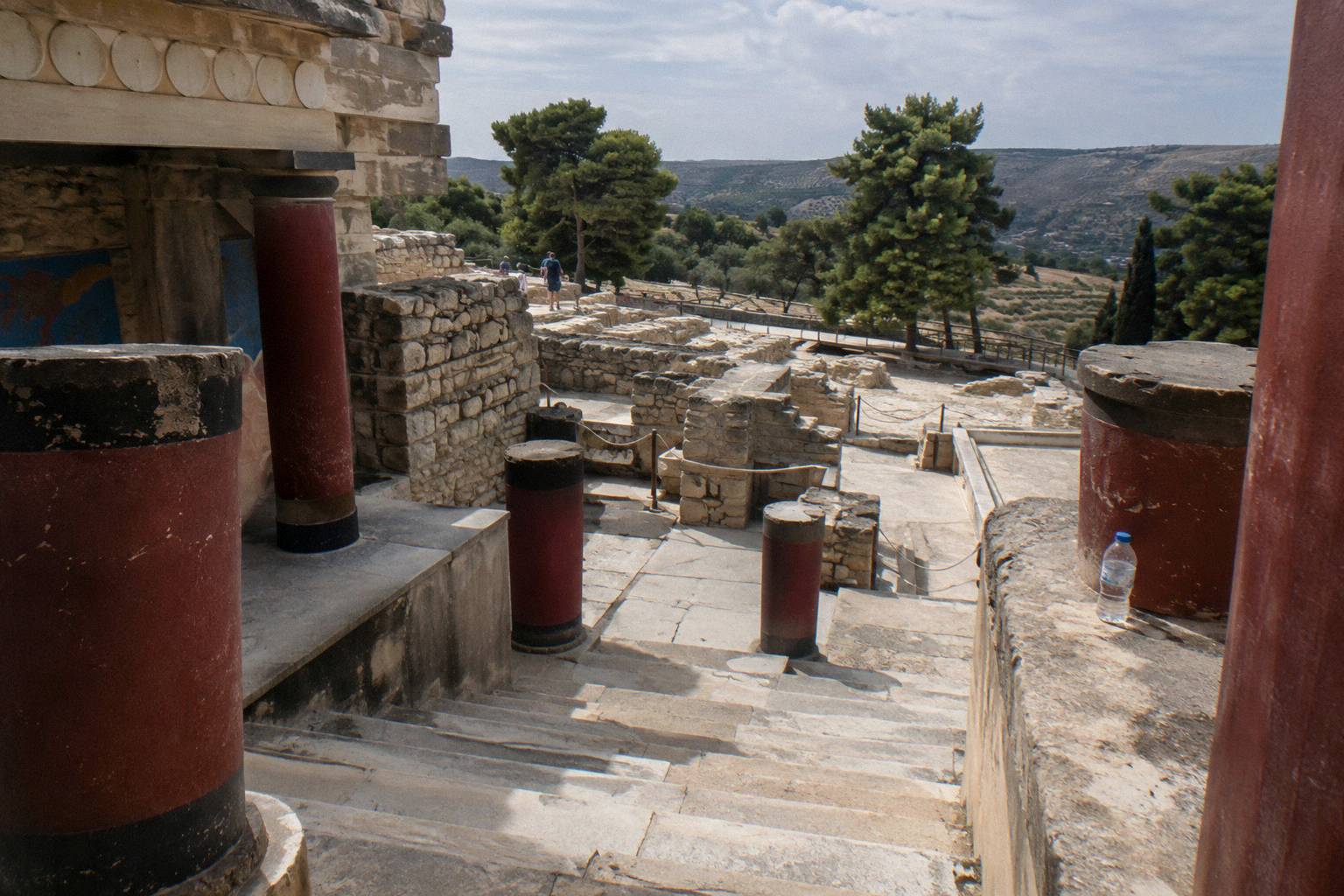
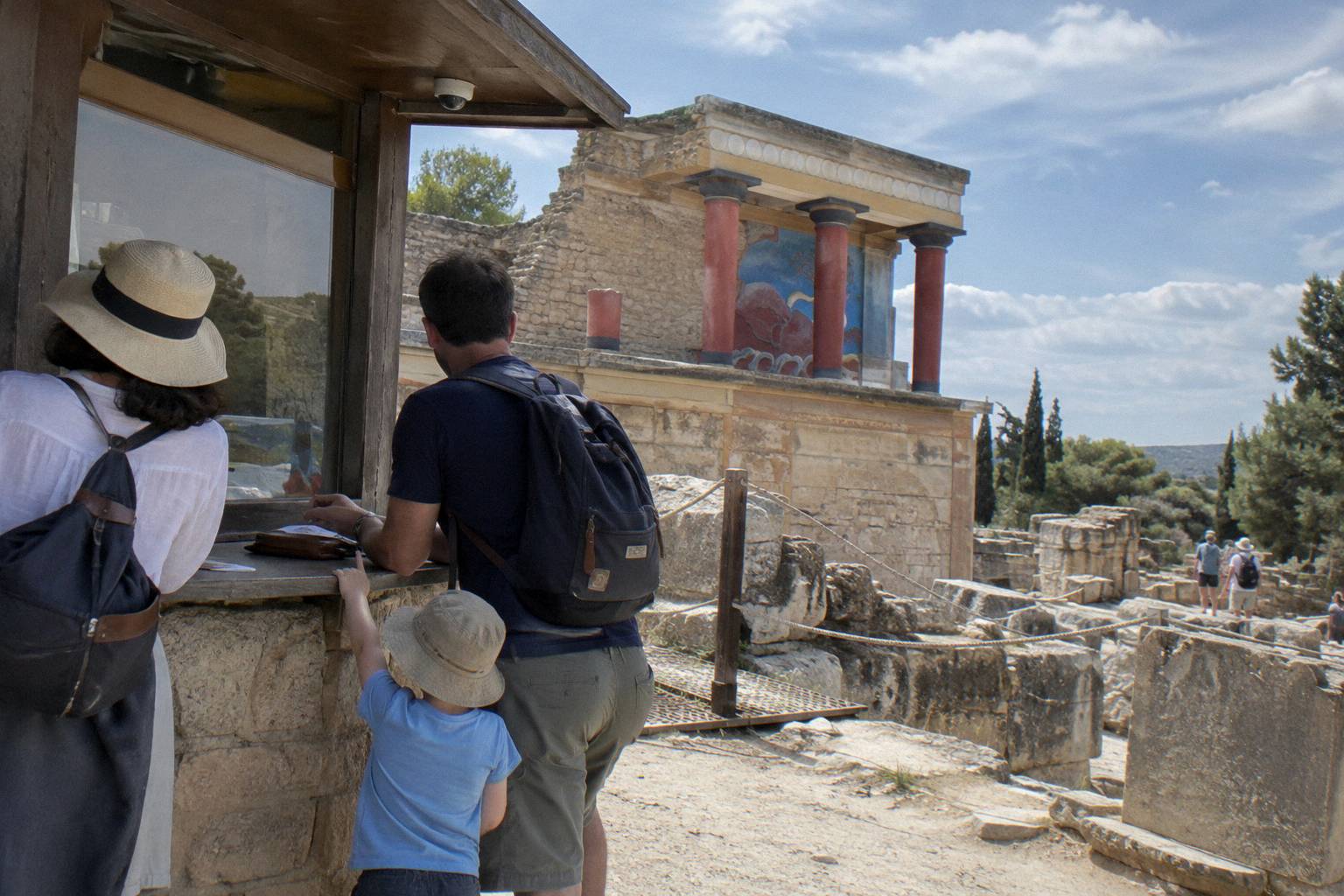
The disputed part starts where the trowel stopped. Where the ruins gave him foundation trenches and the bases of columns, Evans erected full columns in concrete and painted them red. Where a staircase survived only in its lower flights, his team completed the upper ones. Where walls were knee-high, he raised them to head height, sometimes more, so that visitors could read the building as rooms rather than as a plan on the ground. He called parts of the site the Throne Room, the Queen's Megaron and the Priest-King's quarters, names that the Minoans themselves never used and left no record of.
His critics were already at work while the concrete was wet. Contemporary archaeologists accused him of turning a dig into a stage set, of presenting guesswork as restoration, and of making it impossible for later generations to tell ancient fabric from modern. His defenders answered, and still answer, that without the reconstructions a visitor would face a field of wall stubs, and that Evans took care to mark, in the construction itself, which parts were new. Both halves of that exchange continue in archaeological writing today. The honest summary is the one the facts support: the reconstructions are controversial and debated, and even Evans' own colleagues argued about them at the time.
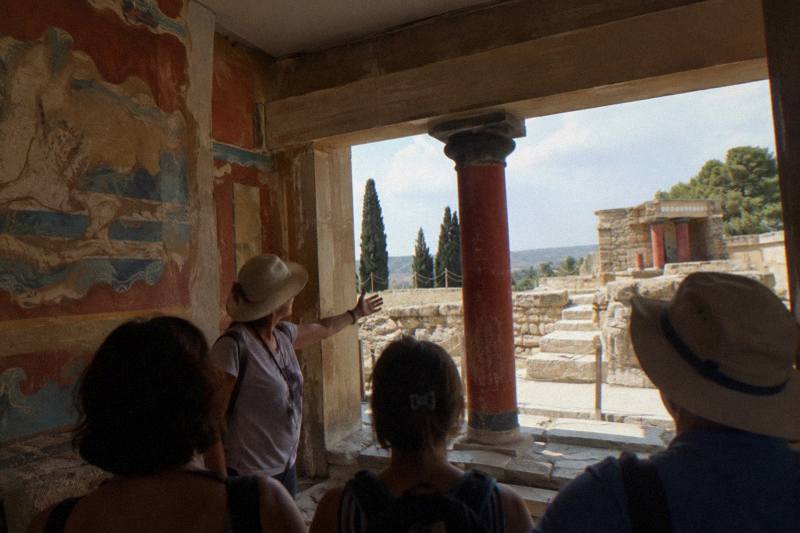
For a visitor, the argument is not an obstacle but an interpretive layer. The controversy is the reason a guided visit at Knossos feels different from a guided visit almost anywhere else in Greece. The guide is not only explaining what a room was; the guide is explaining which centimetres of the room are Bronze Age, which are 1900s concrete, and how anyone knows the difference.
The trips most suited to hearing that explanation are the hour-and-a-half small-group visits, because each of them puts a licensed guide inside the palace with you. The Small Group, Skip The Line trip from Experience Travel Crete (from €89 per person, rated 4.8 across 319 reviews) includes the palace entry ticket and a licensed guide for a guided tour in a group. The KnossosGuides, Ticket Included trip (from €89 per person, rated 4.9 across 48 reviews) does the same with a licensed guide in a small group. Both run an hour and a half, and both include the entry ticket, so the walk starts inside the gate rather than at the ticket counter.
None of that means a guide discusses the Evans controversy on every departure; nothing in any trip entry promises that. But a licensed guide inside the palace is the person qualified to point at a column and say what it is made of and why, and that is the practical value of the debate for the reader deciding how to visit.
What Did Arthur Evans Actually Rebuild At Knossos?
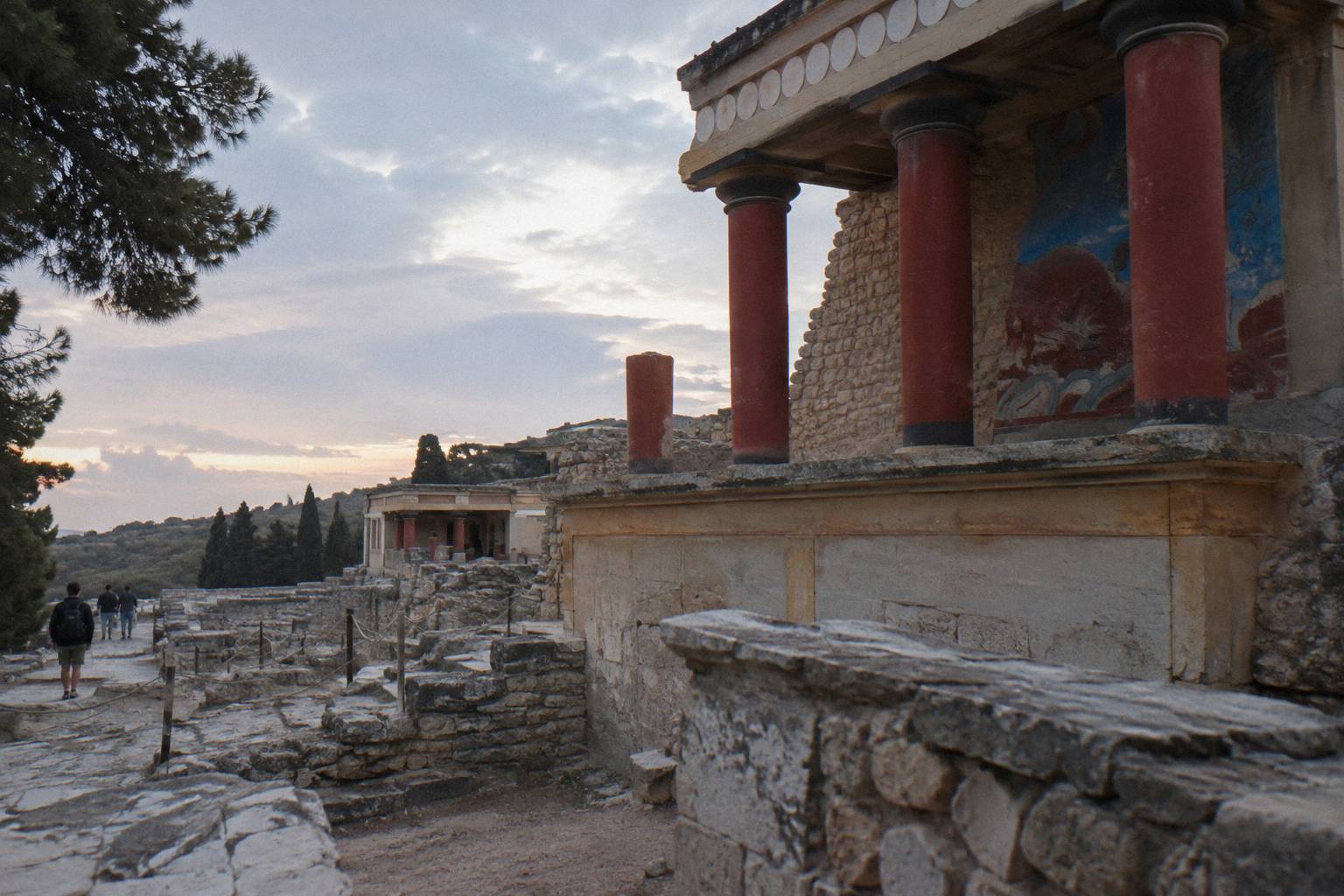
Evans rebuilt in concrete the parts of the palace needed to make it legible: columns with their red-painted shafts and black capitals, sections of wall raised above their surviving height, upper flights of the Grand Staircase and parts of the North Entrance, and he installed copies of frescoes on reconstructed walls. The lower masonry, the paved courts and the storage magazines are largely original second-palace fabric.
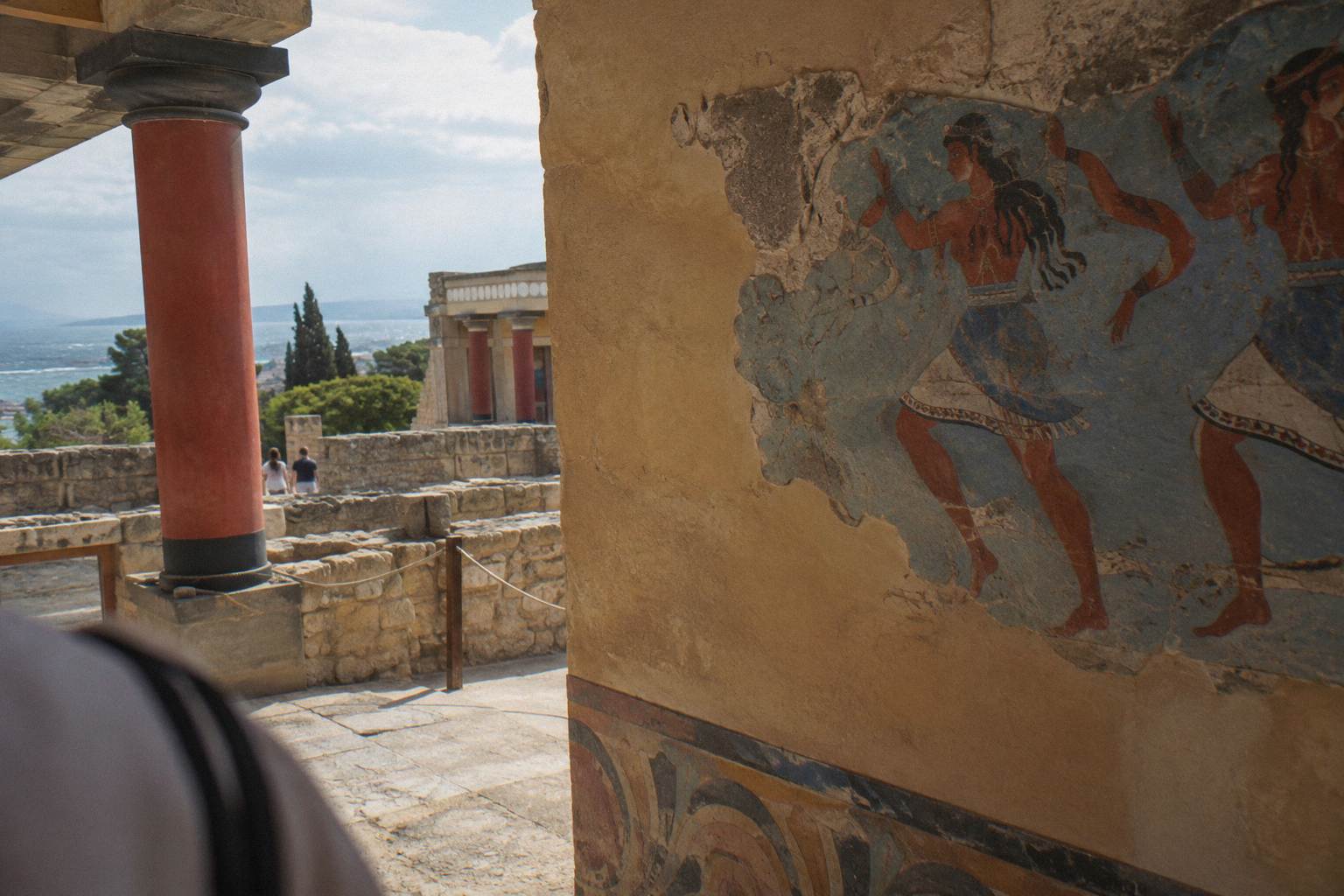
It helps to sort the site into three layers, because they sit side by side everywhere you walk. The first layer is original Minoan work: the gypsum orthostats along wall bases, the paving of the Central Court, the giant storage jars called pithoi in the West Magazines, many of them original, and the foundations under everything. The second layer is Evans' concrete: the columns, the raised walls, the completed staircase. The third layer is paint: the frescoes seen on site are generally copies, with the originals in the Heraklion Archaeological Museum.
The Grand Staircase is the clearest example of all three layers in one place. Its lower flights follow ancient remains closely, and the staircase as a whole is famous for the way it demonstrates that the Minoans built upwards in several storeys. Yet the upper flights are largely reconstructed, and a visitor standing at the top is standing, in part, on Evans' concrete. The staircase is at once the best evidence for Minoan architecture and the best exhibit of Evans' methods.
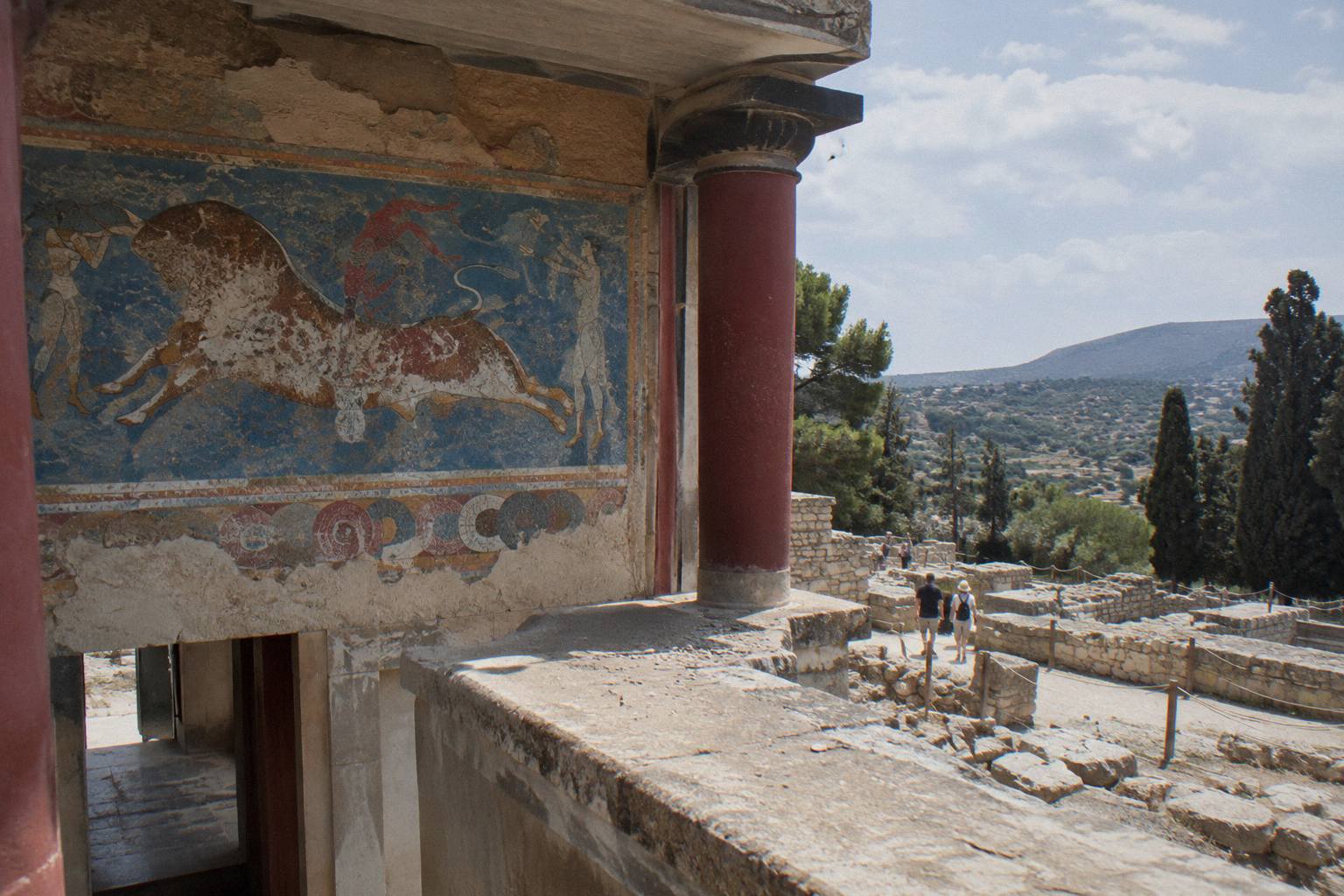
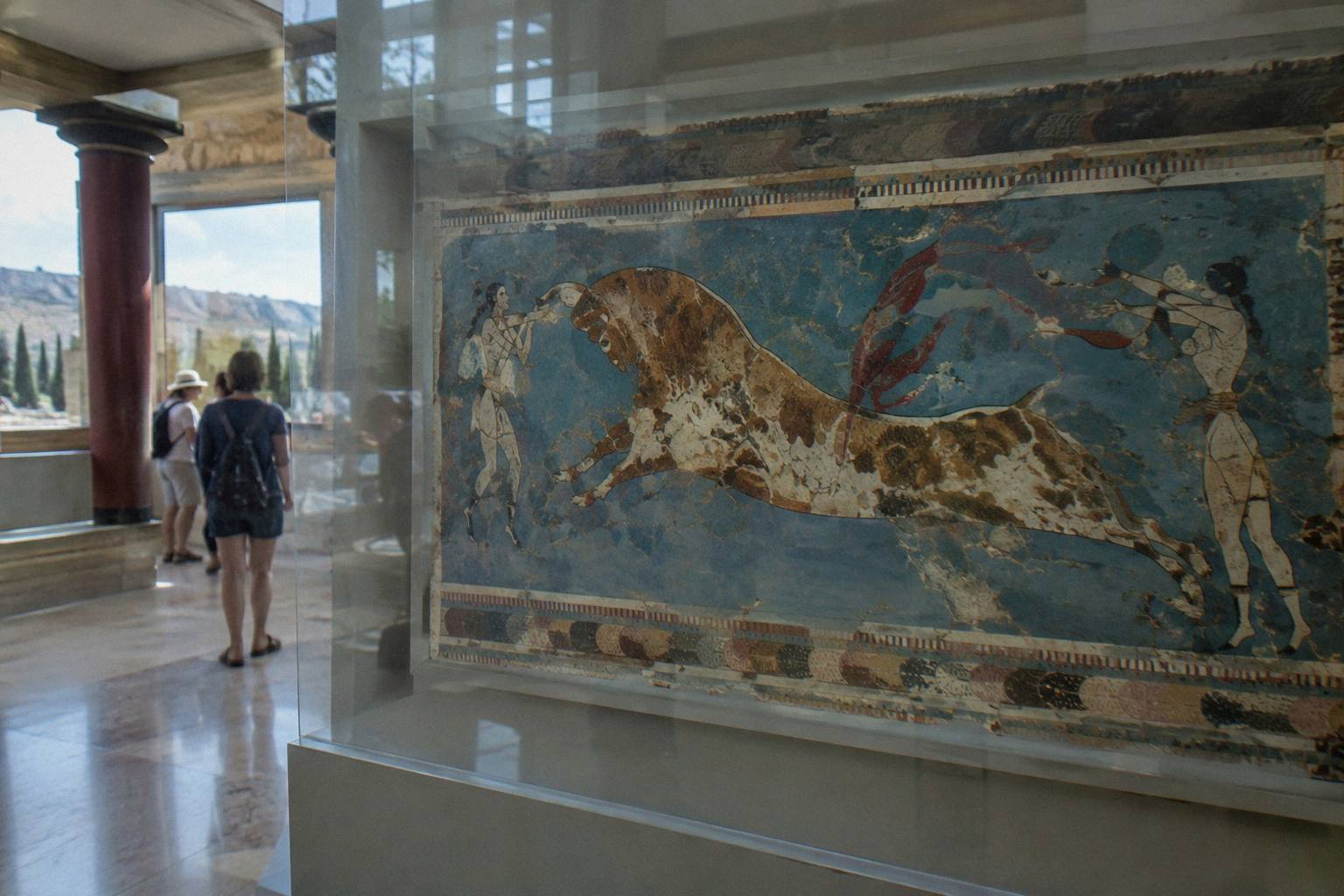
The North Entrance shows the same mix. The reconstructed charging-bull fresco that decorates the passage is a replica; the bull-leaping fragments that inspired the palace's most famous imagery are among the originals held in the Heraklion Archaeological Museum, along with the dolphin fresco and the Prince of the Lilies or Priest-King fragments. The site's most photographed features, in other words, are the ones where reconstruction and copying are densest, which is exactly why visitors who come unprepared leave convinced they have seen original Minoan painting.
Wanting the debate untangled in real time is a good reason to book a guided visit rather than walk the site alone. Free cancellation applies up to 24 hours before the start on the trips covered here.
The site also gained something from the controversy that a purely excavated ruin cannot offer: a sense of vertical scale. Ruined foundations lie flat; Evans' columns and staircases let a visitor feel that the palace rose several storeys around the Central Court. Whether the price, a layer of 1900s concrete mixed into an ancient monument, was worth paying is the question archaeologists still argue, and the visitor gets to judge in person.
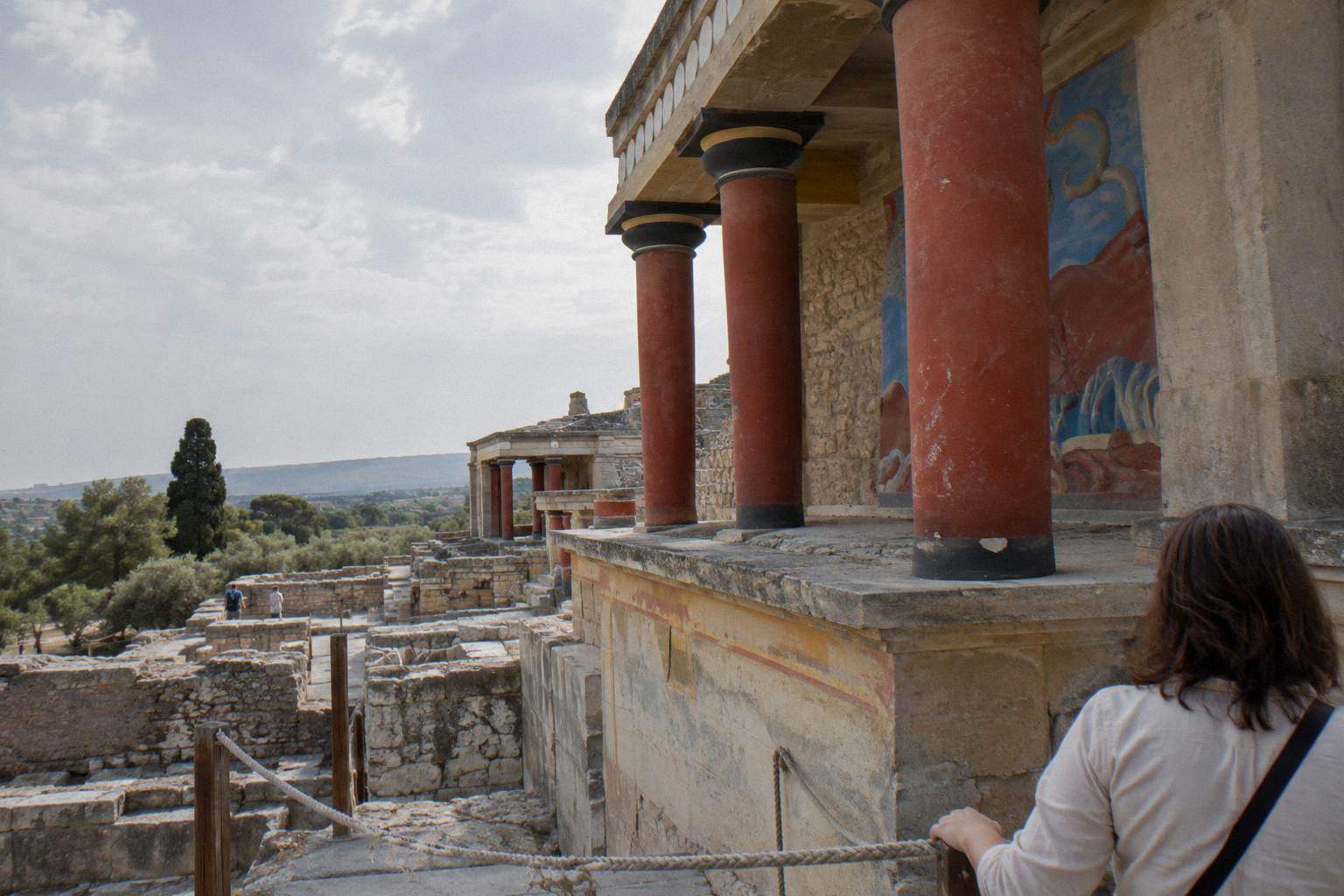
Are The Names Of The Rooms Evans' Inventions?
Yes. The names Queen's Megaron, Priest-King and Throne Room are Arthur Evans' own interpretations, not Minoan labels; no written record survives to say what any room in the palace was used for, and archaeologists do not agree on the functions of the rooms. The Minoan script found at Knossos has never supplied room names for the palace plan.
This is the quieter half of the controversy, and in some ways the more interesting one, because it operates on the visitor's imagination rather than on the masonry. When a plan or a sign says Queen's Megaron, the words carry a story: a queen, a private apartment, a domestic life. Evans chose the name because the room's decoration and layout suggested to him a royal residential quarter. The dolphin fresco copy in that room is real; the queen is not documented anywhere. Calling the room after her was an interpretation, one that archaeologists have questioned ever since.
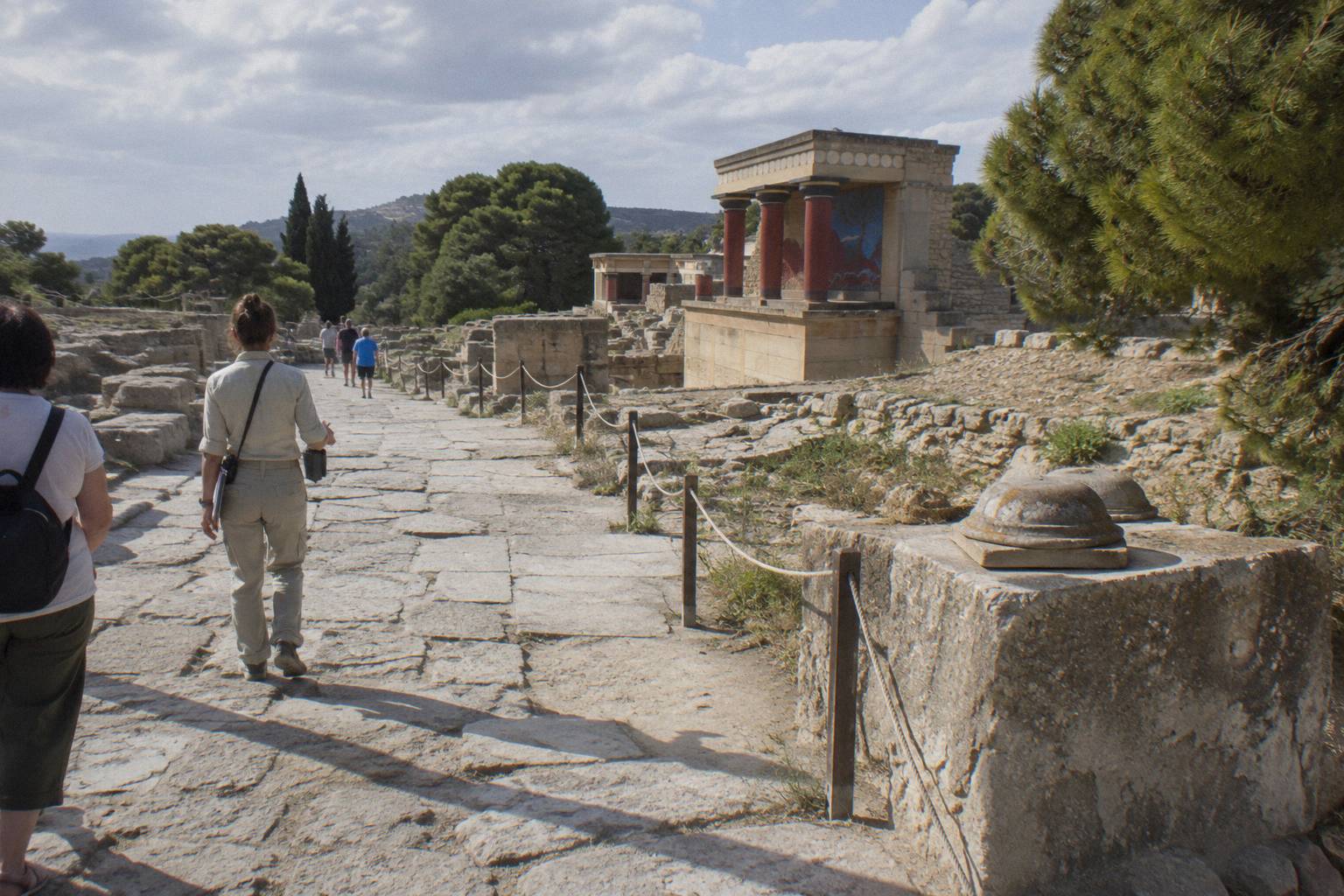
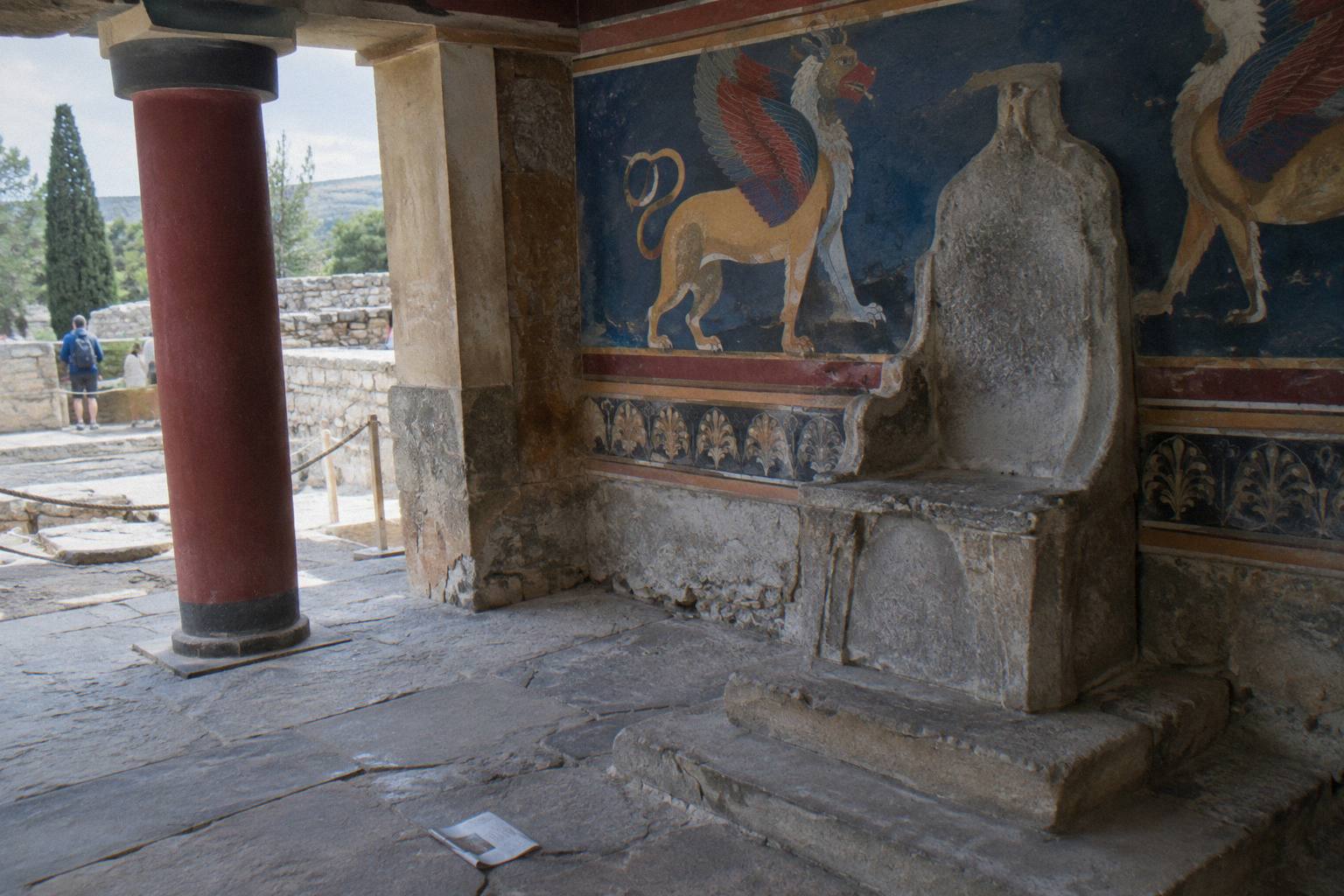
The Throne Room carries the same problem in sharper form. What stands there is physical and can be described without controversy: a small room with a gypsum throne against the wall, benches, a lustral basin and reconstructed griffin frescoes. What the room was used for is debated. Was it a seat of rule, a cult space where a priestess or deity received rites, something else again? Evans read it as a throne room, and the name stuck, but the function is an open question in the literature, and no visitor should repeat the label as though it were a fact.
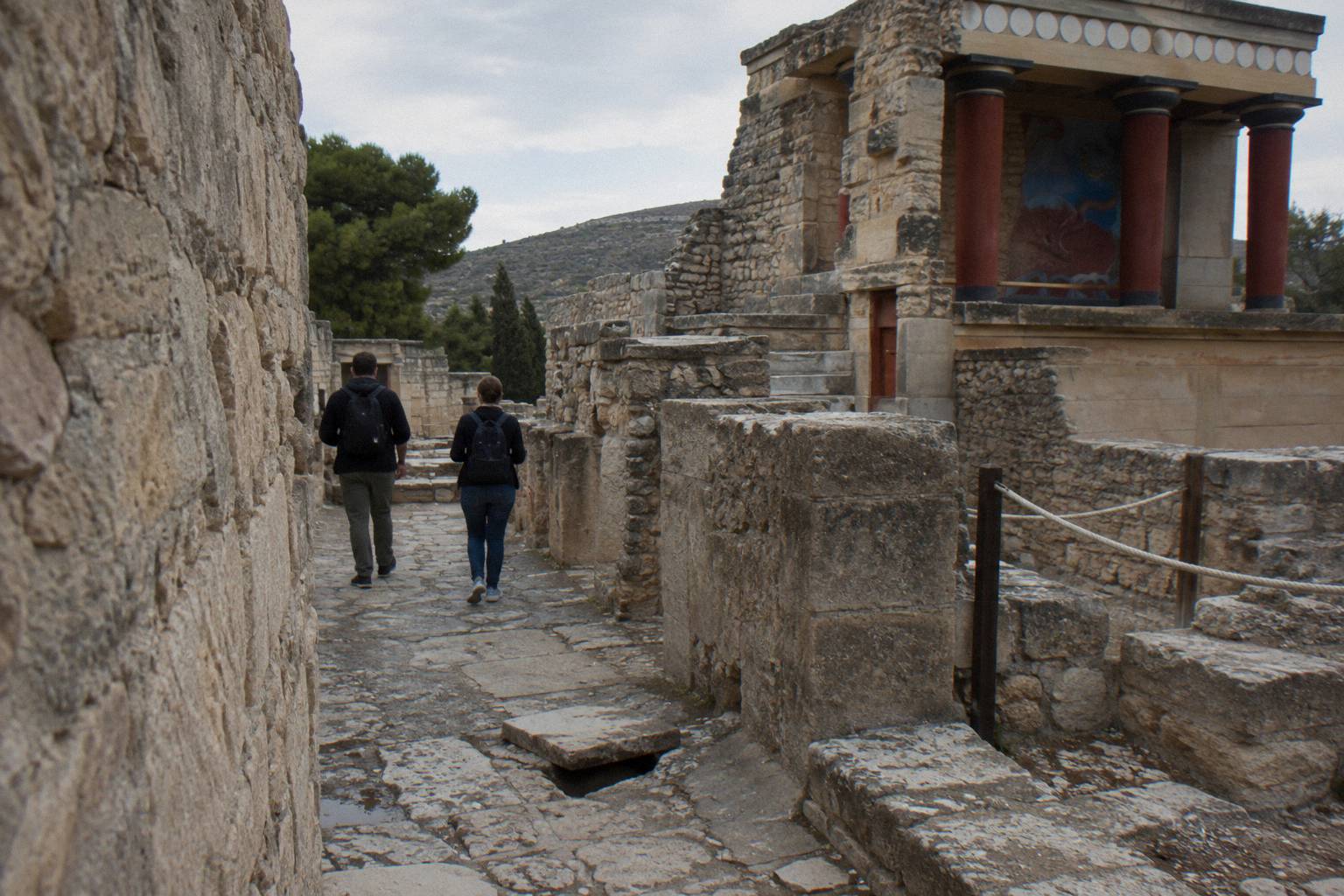
The deeper reason for the uncertainty is the evidence itself. The palace at Knossos was an administrative centre, and clay tablets in the Minoan scripts survived in its archives, but the room names visitors use today come from Evans and his team, not from any Minoan document. The same caution applies to the Priest-King or Prince of the Lilies figure, a name given to reconstructed fresco fragments: the figure's identity, rank and even gender have all been discussed and none of it is settled.
A table keeps the two categories apart:
| Feature on site | Physical status | Name or interpretation |
|---|---|---|
| Throne Room (gypsum throne, benches, lustral basin) | Room and throne ancient; griffin frescoes reconstructed | Evans' name; the room's use is debated |
| Queen's Megaron | Room ancient; dolphin fresco is a copy | Evans' name; no record of a queen |
| Grand Staircase | Lower flights ancient; largely reconstructed overall | Name descriptive, function not in doubt |
| North Entrance bull fresco | Replica on a reconstructed passage | Bull imagery real; placement partly interpretive |
| West Magazines with pithoi | Storerooms and many jars original | Storage function well supported |
For readers who want the imagery side of this in more depth, the guide to Knossos frescoes and the Throne Room and what a guide points out works through the same rooms with the painting in the foreground.
Are The Frescoes At Knossos Original?
Mostly no. The frescoes seen on site are generally copies, and the originals, including the bull-leaping fresco, the dolphin fresco and the Prince of the Lilies or Priest-King fragments, are held in the Heraklion Archaeological Museum. Evans' team lifted the surviving fragments during excavation and had copies made for the reconstructed walls.
This arrangement is standard practice for excavated wall painting and is not itself part of the controversy: sun, rain and thousands of shoulders would destroy the original pigment in years. What Evans added was the painting of whole scenes from small fragments, filling the gaps with his own idea of Minoan art, so a copy on site may represent part ancient fragment and part 1900s imagination. A visitor looking at a reconstructed fresco at Knossos is usually looking at a copy of a restoration of a fragment. The wider set of guides lives on Knossos Greece Tours.
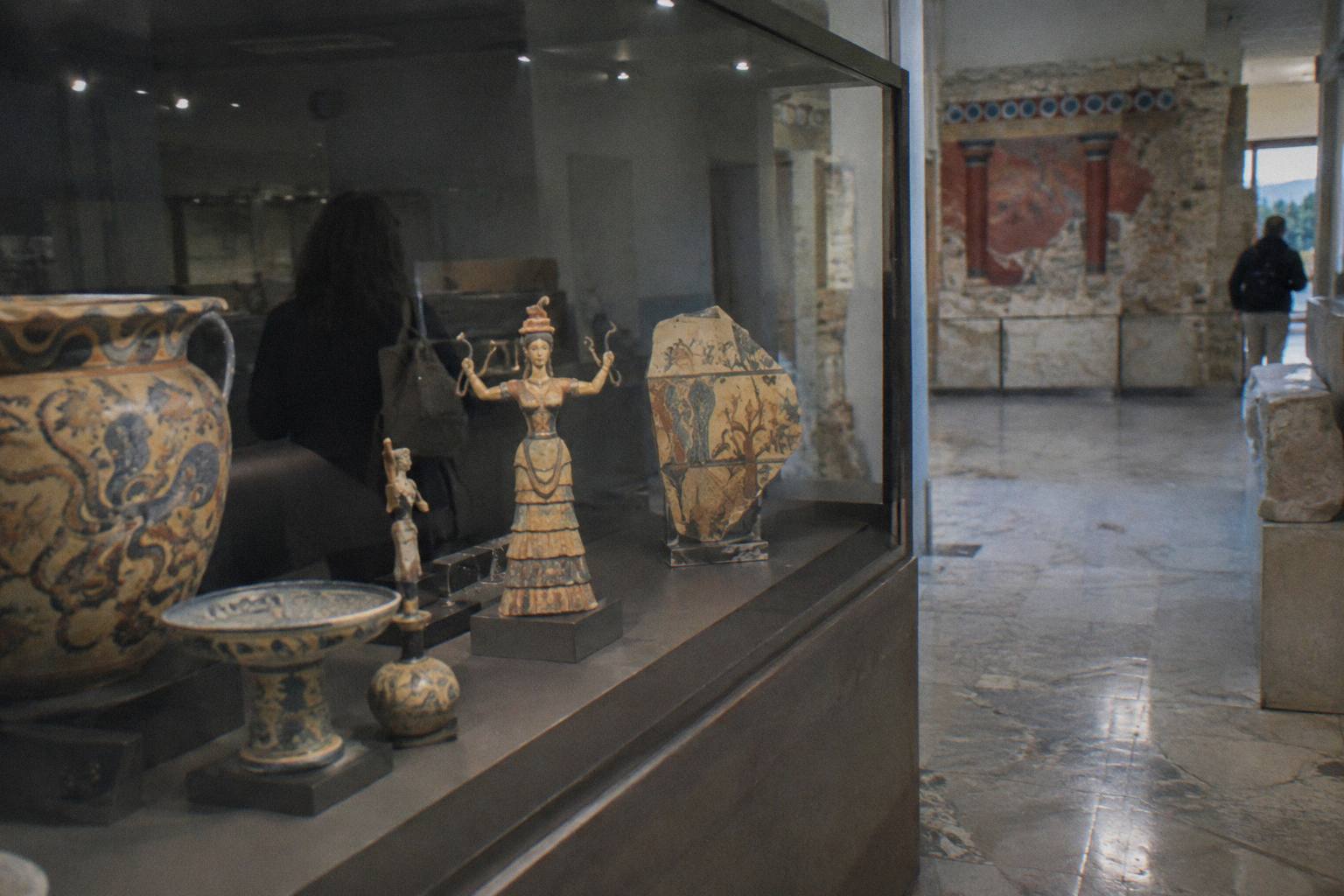
The practical consequence is that the palace and the museum answer different questions. The palace shows the architecture, the scale and the setting; the museum shows the original pigment. The Heraklion Archaeological Museum holds the Minoan finds, including the Phaistos Disc, the bull-leaping fresco and the snake goddess figurines, though no trip covered here promises that you will see any particular object.
Only a handful of trips cover both institutions in one day. The Museum Combo, Small Group trip from Business Management Services L.P. (from €225 per person, rated 4.7 across 37 reviews) is the one that includes entry tickets for both the palace and the Archaeological Museum in its price, with a licensed guide for a small group and skip-the-ticket-line service, over five hours. Several hour-and-a-half palace trips instead offer the museum as an optional add-on.
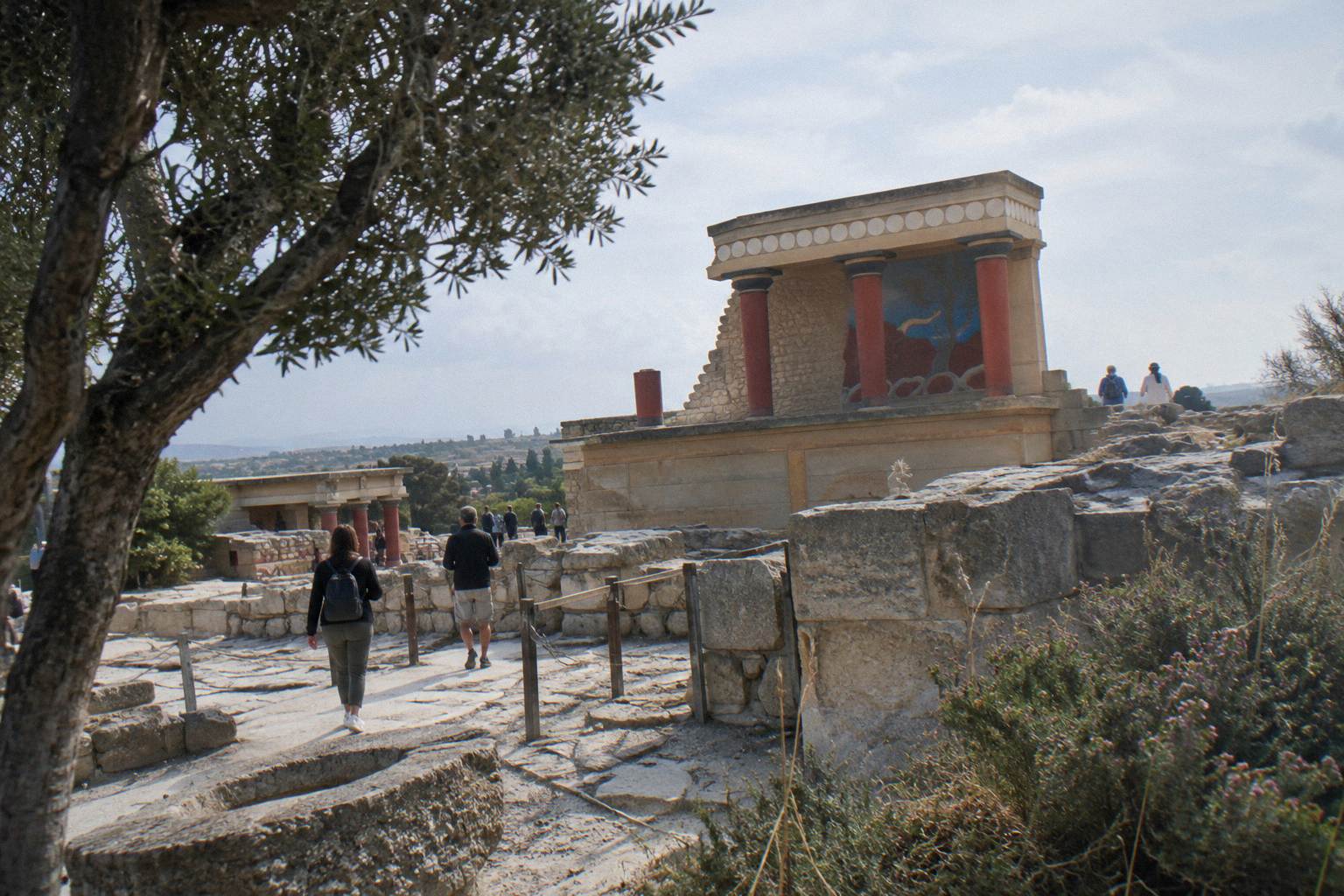
Seeing originals and copies on the same day is the fastest way to understand the reconstruction debate at first hand: the same dolphin appears twice, once as pigment in a case and once as a full-wall copy in a rebuilt room, and the difference between the two is the difference between evidence and interpretation. The pairing of palace and museum on one tour is laid out in detail in the guide to Knossos and the Heraklion Archaeological Museum on one tour.
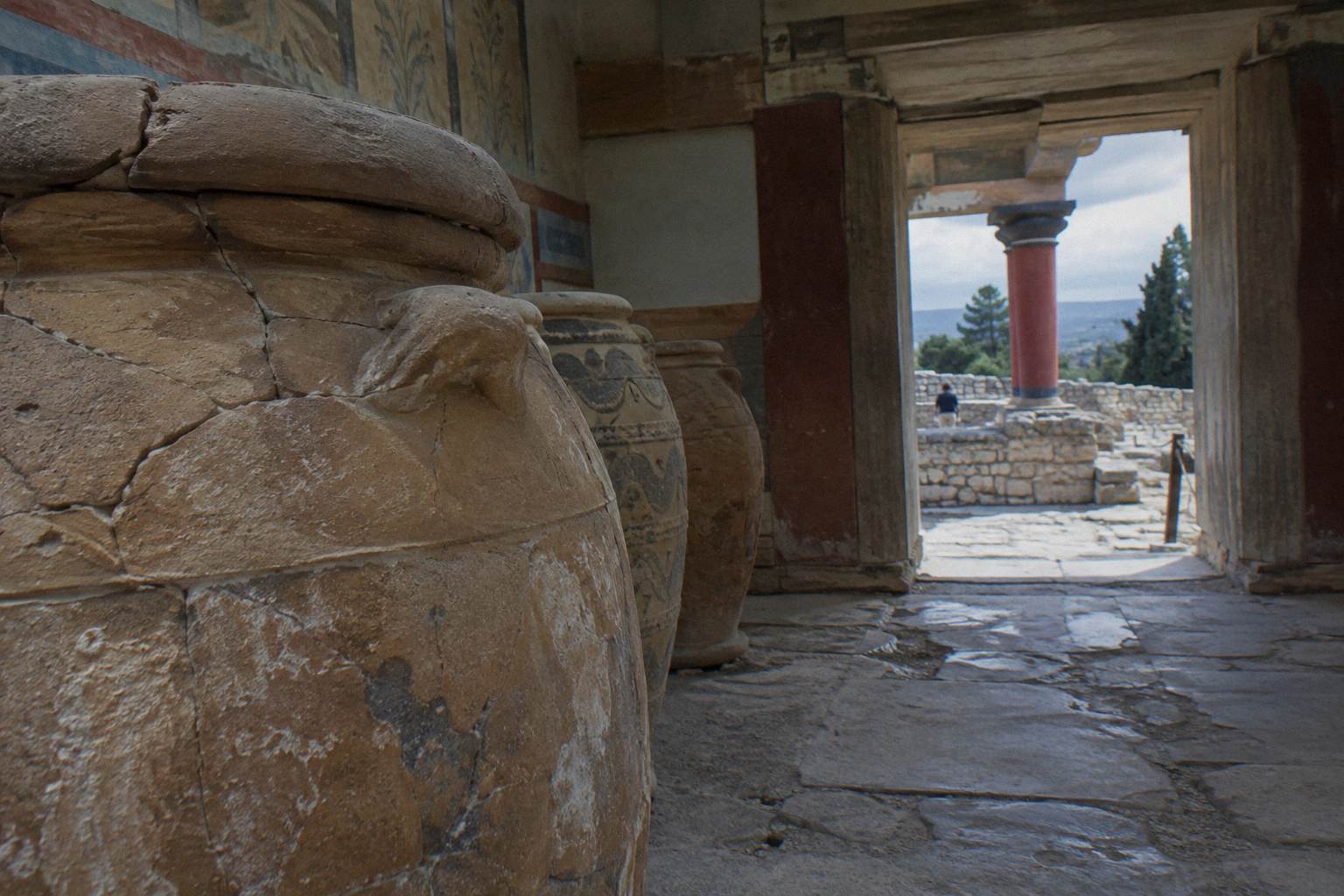
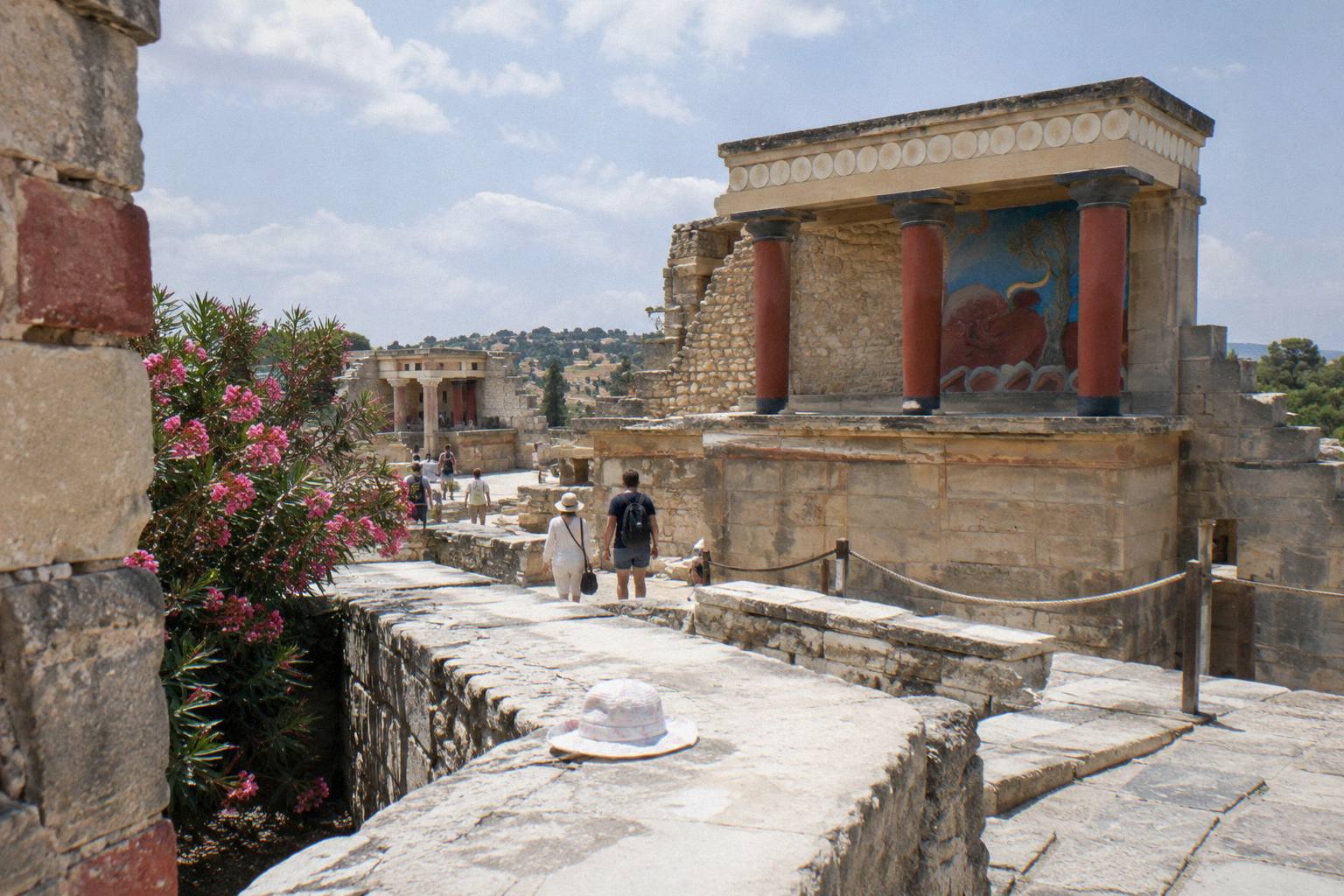
Is The Throne Room What It Looks Like?
The gypsum throne, the benches and the sunken lustral basin are ancient; the griffin frescoes around them are reconstructed, and the room's name and function are Arthur Evans' interpretation. Archaeologists still debate what the room was used for, so the honest answer is that it looks the way Evans believed it should look, arranged around furniture that is genuinely Bronze Age.
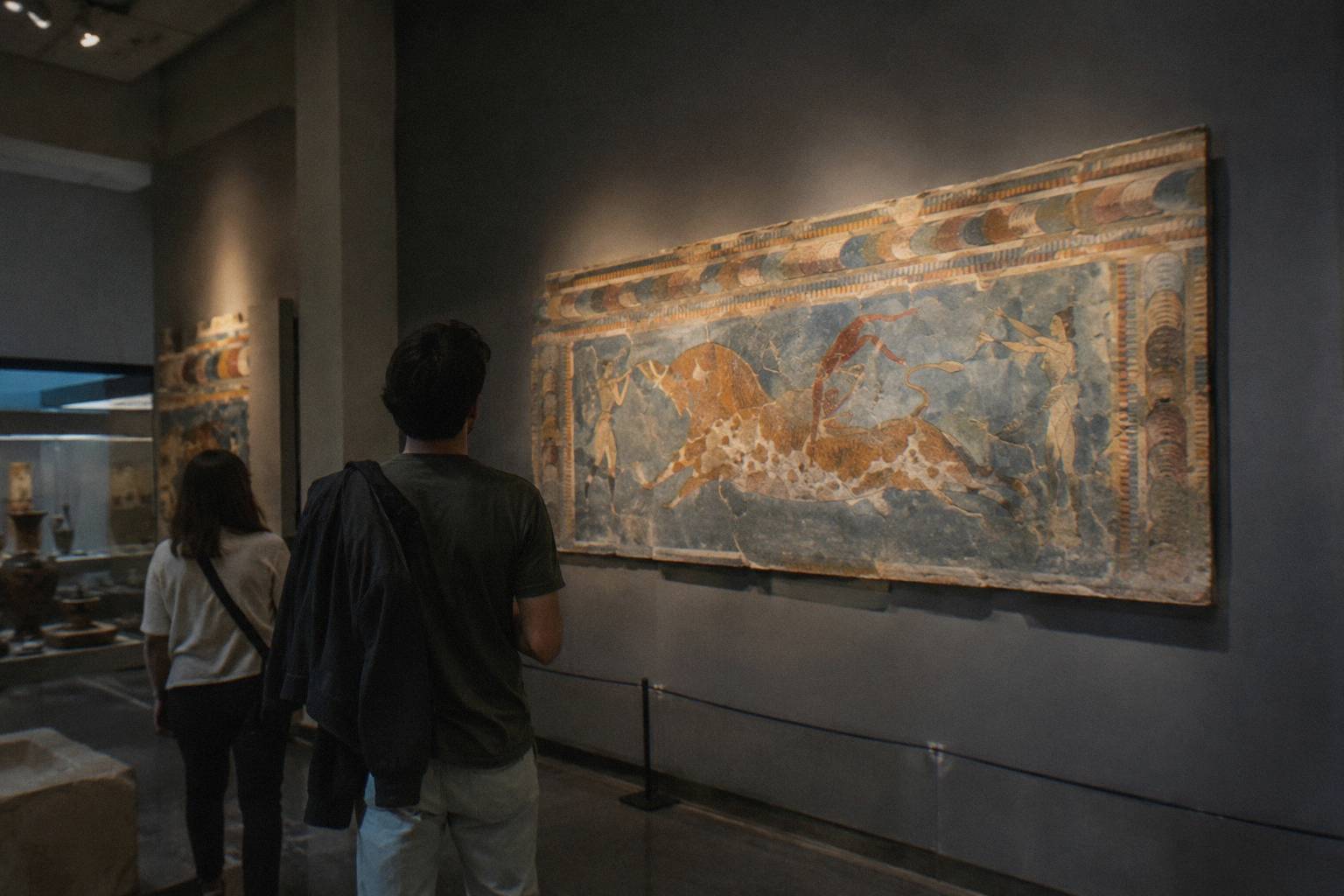
The Throne Room deserves its own section because it is where the controversy becomes almost invisible. A concrete column announces itself; a small dim room with a stone chair in it does not. The throne is real, the basin is real, and the benches are real, which gives the reconstruction an authority it may not deserve. The griffins painted on the walls, guardian creatures flanking the throne, belong to the reconstructed decorative scheme, and the decision to present the room as a seat of power was Evans'.
The debate about function runs in several directions. A throne implies a ruler; a lustral basin, a sunken basin reached by steps, suggests ritual bathing or cult practice in other Minoan contexts; the two readings sit uneasily together, and scholars have proposed priestly, ceremonial and political functions in varying combinations. None of this can be resolved by a visitor in ten minutes, but a visitor who knows the question exists reads the room differently: as an object of debate rather than a stage set with a label.
The legend layer sits on top of all this. The Minotaur, the Labyrinth and Theseus are legend, linked by later Greek tradition to the palace layout; the myth says a labyrinth lay here, and the complexity of the building probably fed the story. No labyrinth exists as a place at Knossos, no guide can show one, and the myth is a story told about the building rather than a description of it. The background to that story is collected in the guide to the Labyrinth of Knossos and what guides say about it.
How A Guided Visit Handles The Reconstruction Question
A licensed guide inside the palace is the person on a visit who can separate ancient masonry from Evans' concrete and original fragments from copies, and on the trips covered here the licensed-guide status is stated trip by trip. The Ticket With Live Guide trip, from €89 per person, pairs a licensed guide with an included entry ticket.
Its full card reads well for this purpose: Business Management Services L.P., rated 4.6 across 78 reviews, a one-and-a-half-hour small-group visit with skip-the-ticket-line service and the palace ticket in the price. That combination, licensed guide plus included entry, is the practical version of the reconstruction question: the walk starts inside the gate, with a qualified person in front of the concrete.
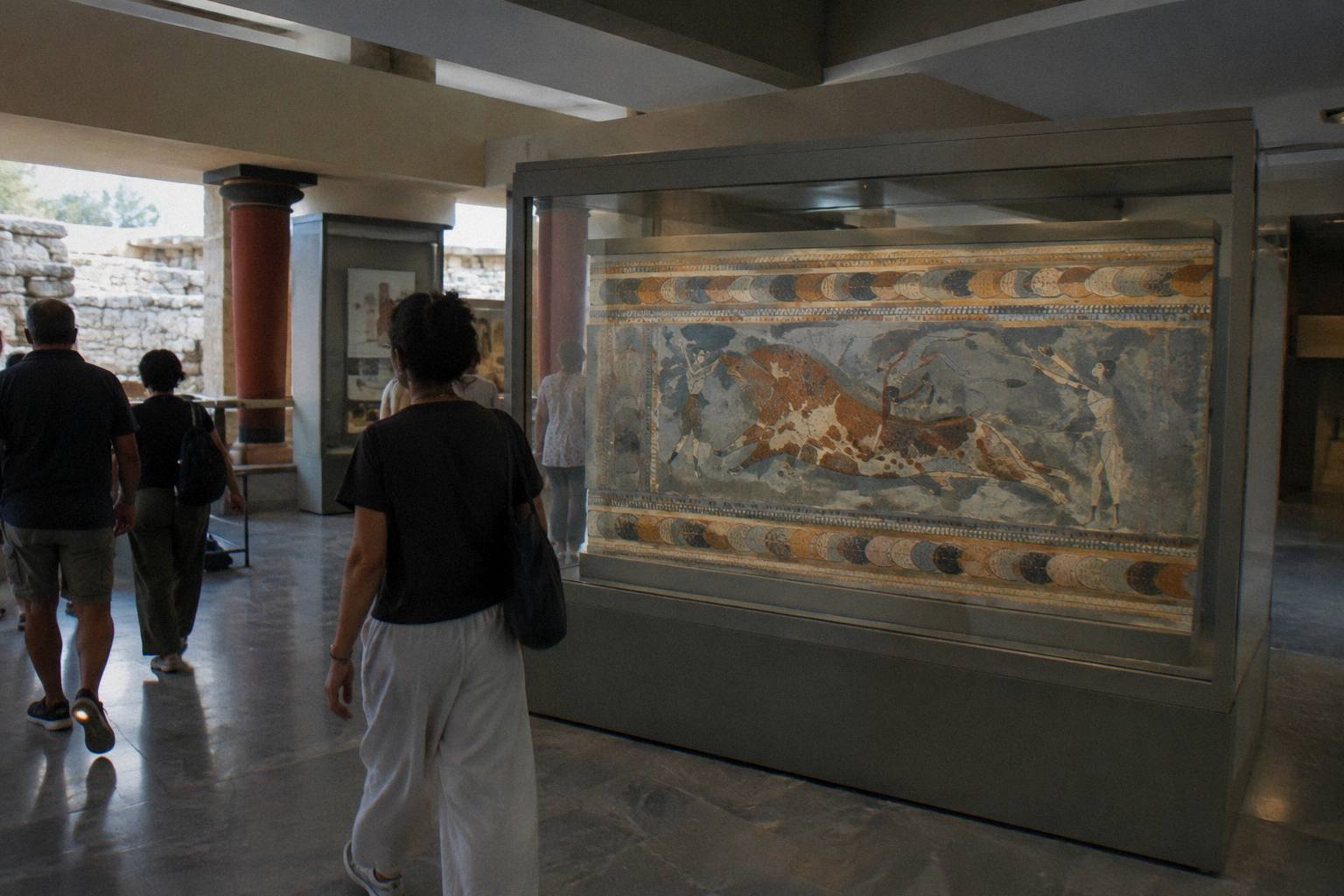
No trip entry promises a lecture on Evans; what the entries state is who guides inside the palace, and that is the part worth checking when the reconstruction debate is the reason for your visit. On the shared small-group trips from Business Management Services L.P., Experience Travel Crete and KnossosGuides, the guide inside the palace is a licensed tour guide, headset when the group is over 6. On several private day trips the situation differs: the person with you is a driver guide or driver only, and a licensed guide inside the palace is an optional extra, at extra charge, with no figure given. Whether the guide is licensed or just the driver is a difference that matters most on a site where half the question is what is real.
The full Ticket With Live Guide visit covers the palace in a small group with a licensed guide, skip-the-ticket-line service and the entry ticket in the price; Check availability if that format suits. It also offers the Archaeological Museum as an optional add-on, which is how a look at the fresco originals can follow the palace walk on the same booking.
The budget end of the scale deserves a mention because the guide question is not only about money. The Budget Fare Guided Walk from Business Management Services L.P. (from €60 per person, rated 4.9 across 63 reviews) also runs with a licensed guide in a small group; the difference is that the palace entry ticket is excluded and paid separately, with a skip-the-line service handled through the check-in operator. Paying less for the walk and buying the ticket on the official schedule is a perfectly good way to get a licensed guide in front of the concrete columns.
The Private Half Day, Cruise Friendly trip from SunSud Tours shows the other pattern clearly: from €62, rated 5.0 across 108 reviews, with harbour, hotel or meeting-point pickup in a private van and a driver-host, but a licensed guide inside the palace is an optional extra at extra charge. That is a fine format for travellers who want flexibility; readers whose main interest is the Evans question should know the guiding difference before choosing it. More on that format in the guide to whether a private Knossos tour is worth the extra cost.
What Trips People Up When Booking A Knossos Tour?
The recurring traps are assuming every trip includes the palace ticket, assuming every driver is a licensed palace guide, and expecting a reconstruction commentary that no trip entry promises. Each of those is settled by reading the trip's own inclusions before booking, since entrance and guiding differ from trip to trip at Knossos.
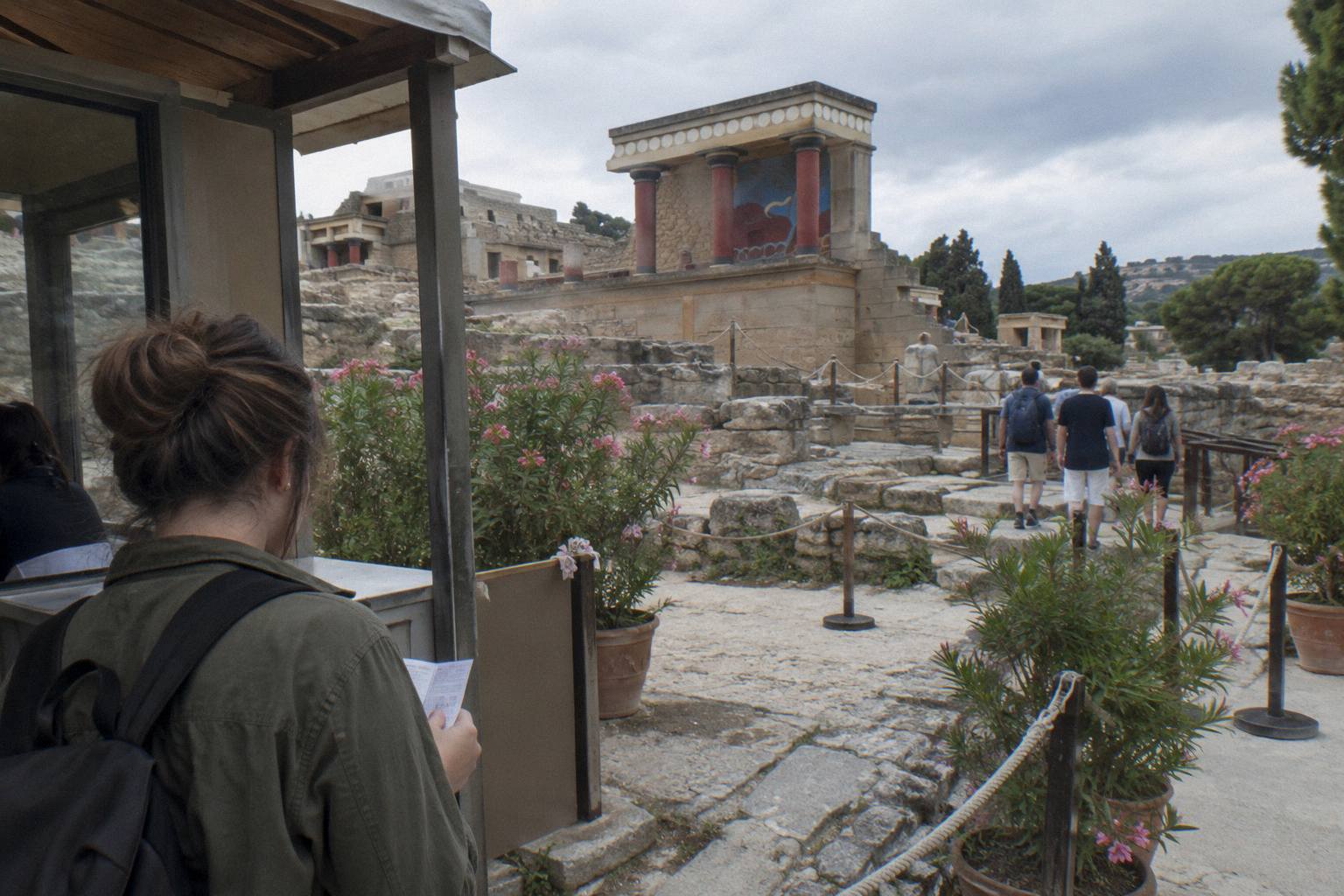
The entrance ticket is the most common stumble. Some trips include it: Small Group, Skip The Line; Ticket With Live Guide; KnossosGuides, Ticket Included; Early Morning Entry; Bus Transfer, Entry Ticket; and the Museum Combo. Many others exclude it, including the budget walks, most coach days and nearly every Lasithi and Zeus Cave trip. A low headline price that excludes the €20 full ticket on the official Ministry of Culture schedule can end up close to a higher price that includes it.
The guide is the second. On the shared small-group visits a licensed guide inside the palace is included. On private van days the licensed guide is typically an extra, and on a coach day such as the Budget 8-Hour Coach Tour from Altino Travel Services (from €33 per person, rated 4.2 across 94 reviews) the licensed guide is included but the palace and museum entrances are not, with the guiding language varying by weekday. The combinations do not repeat from trip to trip, so a fact true of one is never carried to another.
| Trip | Palace ticket | Who guides inside the palace |
|---|---|---|
| Ticket With Live Guide, from €89 per person | Included | Licensed tour guide, small group |
| Budget Fare Guided Walk, from €60 per person | Excluded, paid separately | Licensed tour guide, small group |
| Museum Combo, Small Group, from €225 per person | Included, museum too | Licensed tour guide, small group |
| Private Half Day, Cruise Friendly, from €62 | Excluded | Driver-host; licensed guide an optional extra |
| Budget 8-Hour Coach Tour, from €33 per person | Excluded | Licensed guide included, whispers at the palace |
The third trap is expectation, and it connects back to the whole subject of this piece. No trip here promises that the guide will discuss Evans' reconstructions; what the trips state is who is guiding and what is included. A licensed guide standing in front of a concrete column is the best available chance of hearing the debate addressed on site, but the debate itself is best carried in by the visitor, which is why the context in what you see at the Palace of Knossos on a guided visit is worth reading before the day. The Knossos Greece Tours site gathers the trips and the background in one place, from the ticket-only question to the long coach days.
The last practical point is the schedule itself. Palace hours follow the official Ministry of Culture schedule, seasonal and changing by year: summer hours run from 08:00 to 20:00 from 1 April, with closing times shortening through autumn, and winter closing in the late afternoon, with free admission on a handful of set days and closure notices posted on the official page. A trip's own duration and start arrangements always win over any general schedule, but knowing the official shape of the day helps when comparing an early-morning trip against a midday one.
Whichever trip fits, the reconstruction question travels with you. The concrete is part of the monument now, listed as part of its story, and the visitor who knows which columns are Evans' and which storage jars are Minoan gets more from an hour and a half on site than the visitor who does not.
Common Questions About Knossos And The Evans Reconstructions
Why Is Knossos Controversial? Evans And The Reconstructions
Arthur Evans excavated Knossos from 23 March 1900 and then rebuilt parts of it in concrete: columns, walls and staircases. His reconstructions and his room names, such as the Queen's Megaron and the Throne Room, are interpretations that archaeologists have debated since his own lifetime.
Did Arthur Evans Own The Site Of Knossos?
Yes. Evans bought the site and in 1924 donated it to the British School at Athens. His systematic excavation had begun on 23 March 1900, after Minos Kalokairinos made the first excavations in 1878.
Are The Frescoes At Knossos Real?
The frescoes seen on site are generally copies. The originals, including the bull-leaping fresco, the dolphin fresco and the Prince of the Lilies or Priest-King fragments, are in the Heraklion Archaeological Museum.
Is The Throne Room At Knossos Genuine?
The gypsum throne, the benches and the lustral basin are ancient, but the griffin frescoes are reconstructed and the room's name is Evans' interpretation. What the room was used for is still debated.
Will A Tour Guide Explain The Reconstructions?
No trip entry promises a discussion of Evans, but a licensed guide inside the palace is qualified to point out what is ancient and what is reconstructed. On the shared small-group visits a licensed guide is included; on most private van days a licensed palace guide is an optional extra.
What Is The Labyrinth Of Knossos?
Legend, not a place. The Minotaur, the Labyrinth and Theseus are myth, linked by later Greek tradition to the palace layout. The palace is a real and complex Bronze Age building; the labyrinth is a story told about it.